
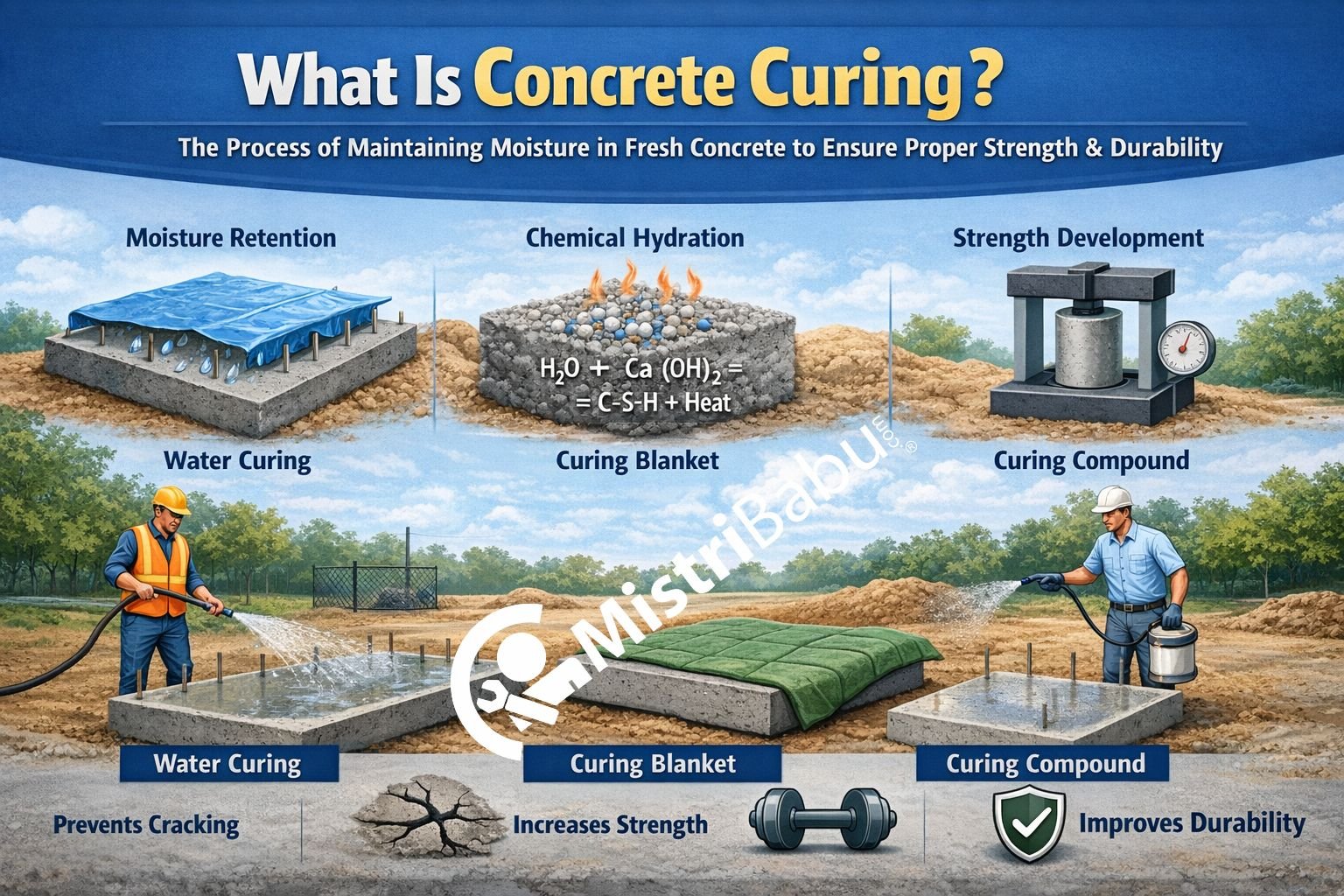
Concrete curing is one of the most critical steps in construction. Whether you are building a house in coastal Puri, a commercial complex in Bhubaneswar, or a rural home in Kalahandi, proper curing ensures long-lasting strength, durability, and crack-free concrete.
In a state like Odisha, where climate conditions vary from humid coastal regions to dry western districts, understanding concrete curing is essential for every homeowner, contractor, and builder.
What Is Concrete Curing?
Concrete curing is the process of maintaining adequate moisture, temperature, and time after concrete placement to allow proper hydration of cement.
When cement mixes with water, a chemical reaction called hydration occurs. This reaction helps concrete gain strength. If water evaporates too quickly (which is common in hot or windy weather in Odisha), the concrete may:
-
Develop cracks
-
Lose strength
-
Become weak and porous
-
Reduce durability
Proper curing ensures the concrete reaches its designed strength and performance level.
Why Concrete Curing Is Important in Odisha?
Odisha’s climate creates unique challenges:
1️⃣ Coastal Humidity (Puri, Ganjam, Jagatsinghpur)
High moisture and salty air increase corrosion risk. Proper curing improves density and resistance to chloride attack.
2️⃣ High Summer Temperatures (Sambalpur, Balangir, Kalahandi)
Extreme heat causes rapid water evaporation. Without curing, cracks develop quickly.
3️⃣ Heavy Monsoon (All districts)
Irregular rainfall may disturb fresh concrete if not protected properly.
Because of these climatic conditions, curing is not optional — it is mandatory for structural safety.
Types of Concrete Curing Methods Used in Odisha
1️⃣ Water Curing (Most Common)
-
Ponding method (for slabs)
-
Sprinkling
-
Wet gunny bags
✔ Best for residential houses
✔ Affordable and effective
2️⃣ Membrane Curing
-
Liquid curing compounds sprayed on surface
-
Forms a protective layer
✔ Suitable for large projects
✔ Used in highways and commercial buildings
3️⃣ Steam Curing
-
Used in precast concrete
-
Accelerates strength gain
✔ Used in industrial projects
4️⃣ Plastic Sheet Covering
-
Polythene sheets prevent evaporation
-
Common in small residential construction
How Long Should Concrete Be Cured?
| Concrete Type | Minimum Curing Time |
|---|---|
| Ordinary Portland Cement (OPC) | 7 days |
| PPC Cement | 10–14 days |
| Slabs & Roof | 14 days recommended |
| Columns & Beams | 10 days minimum |
? In hot districts like Boudh or Nuapada, curing should continue longer to prevent early drying.
Step-by-Step Concrete Curing Process
-
Allow initial setting (6–10 hours after pouring)
-
Start gentle water sprinkling
-
Maintain continuous moisture
-
Avoid surface drying
-
Continue for recommended days
-
Protect from heavy rain during early stage
Common Mistakes in Concrete Curing
❌ Starting curing too late
❌ Stopping after 2–3 days
❌ Uneven water application
❌ No curing for columns
❌ Ignoring curing during winter
These mistakes reduce structural lifespan drastically.
Concrete Curing for House Construction in Odisha
If you are constructing a home in Odisha, curing is required for:
-
Footings
-
Columns
-
Beams
-
Roof slab
-
Staircase
-
Boundary walls
Even plastering work requires curing for at least 7 days.
All Districts of Odisha Covered
Concrete curing is important in every district of Odisha:
-
Angul
-
Balangir
-
Balasore
-
Bargarh
-
Bhadrak
-
Boudh
-
Cuttack
-
Deogarh
-
Dhenkanal
-
Gajapati
-
Ganjam
-
Jagatsinghpur
-
Jajpur
-
Jharsuguda
-
Kalahandi
-
Kandhamal
-
Kendrapara
-
Kendujhar (Keonjhar)
-
Khordha
-
Koraput
-
Malkangiri
-
Mayurbhanj
-
Nabarangpur
-
Nayagarh
-
Nuapada
-
Puri
-
Rayagada
-
Sambalpur
-
Subarnapur (Sonepur)
-
Sundargarh
Whether your project is in rural villages or growing cities like Bhubaneswar, proper curing practices must be followed strictly.
Advantages of Proper Concrete Curing
✔ Higher compressive strength
✔ Reduced cracking
✔ Increased durability
✔ Better surface finish
✔ Improved water resistance
✔ Longer building lifespan
Disadvantages of Improper Curing
❌ Weak concrete
❌ Surface dusting
❌ Structural cracks
❌ Reduced load-bearing capacity
❌ Early repairs and maintenance cost
Concrete Curing Cost in Odisha
Curing cost is generally included in labor charges. However:
-
Water curing cost depends on water availability
-
Labor for curing: ₹3–₹8 per sq.ft (approx.)
-
Membrane curing compounds cost extra
Investing in curing saves thousands in future repairs.
1️⃣ What happens if concrete is not cured properly?
Concrete will lose strength, develop cracks, and may fail structurally over time.
2️⃣ How many days should slab curing be done in Odisha?
Minimum 14 days is recommended due to hot climate conditions.
3️⃣ Is curing required during winter in Odisha?
Yes. Even in winter, curing is necessary to complete cement hydration.
4️⃣ Can we cure concrete with plastic sheets only?
Yes, but it is less effective than water curing unless properly sealed.
5️⃣ When should curing start after concrete pouring?
Usually 6–10 hours after placement, once the surface hardens.
6️⃣ Is curing required for plastering?
Yes. Plaster must be cured for at least 7 days.
7️⃣ Which curing method is best for Odisha climate?
Water curing is the most reliable and commonly used method across districts.
Final Thoughts
Concrete curing is not just a routine construction step — it is the foundation of building strength and durability. In a diverse climate state like Odisha, proper curing ensures your home stands strong for decades.
Whether you are constructing in Angul, Cuttack, Puri, Sambalpur, or any other district, never compromise on curing quality.
If you need professional construction guidance, always consult experienced engineers and contractors who understand Odisha’s local climate and soil conditions.

MistriBabu
Admin