
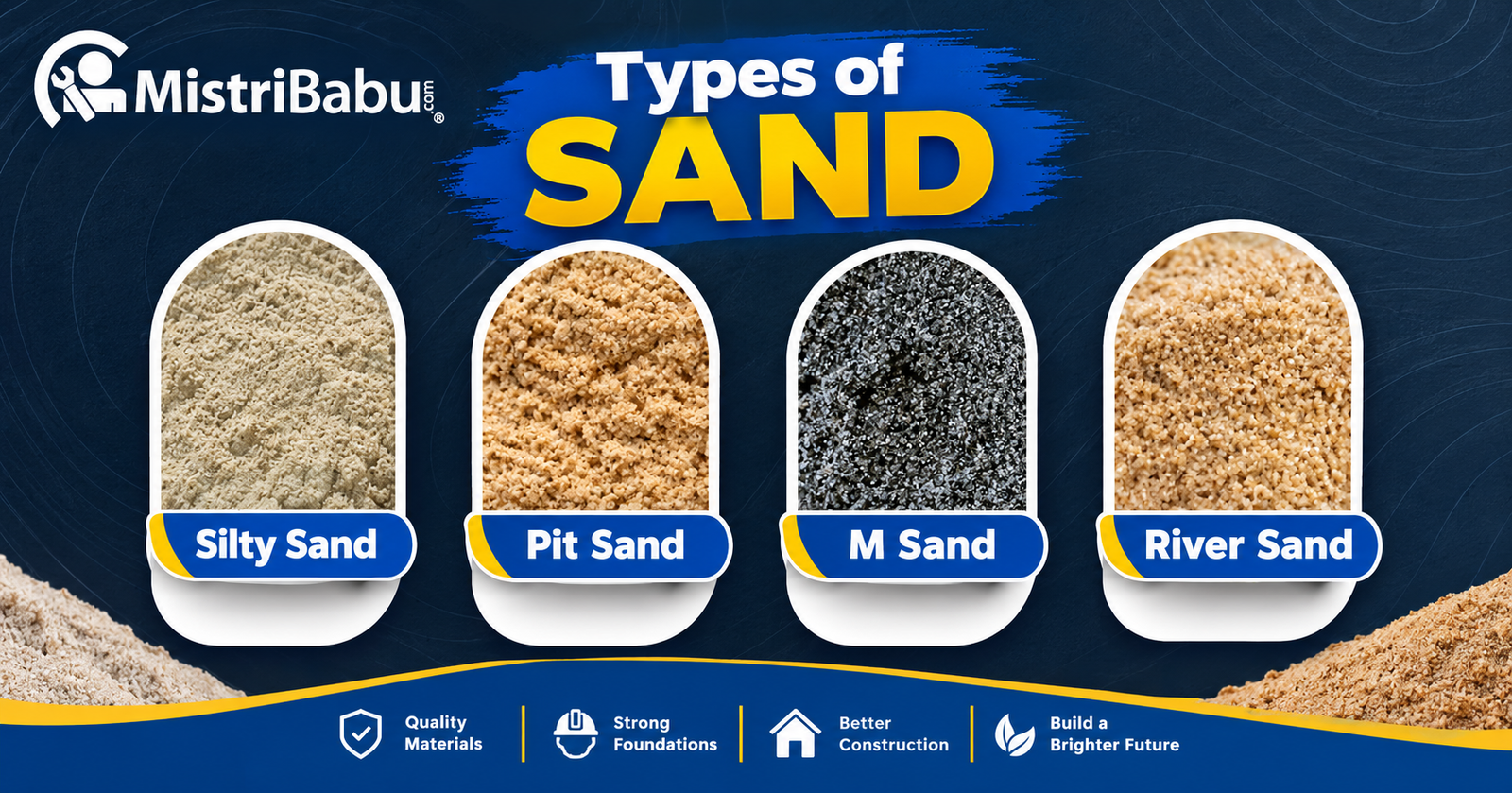
Sand is one of the most important construction materials used in residential buildings, commercial complexes, roads, bridges, boundary walls, plastering, flooring and infrastructure projects. Selecting the right type of sand affects the strength, durability, workability and finish of a building.
In India, sand requirements vary according to geology, rainfall, coastal conditions, local availability and construction specifications. Whether you are constructing a house in Bhubaneswar, renovating a flat in Delhi, building a villa in Bengaluru or developing a commercial property in Mumbai, choosing suitable and properly graded sand is essential.
This guide explains the different types of construction sand, their uses, advantages, limitations, quality checks and regional considerations across Indian states, districts and cities.
1. Why Is Sand Important in Construction?
Sand is used in different stages of building construction because it contributes to the required consistency, grading and workability of construction materials.
Concrete preparation: Used as fine aggregate in concrete mixes.
Brickwork and blockwork: Mixed with cement or other specified binders to prepare mortar.
Wall plastering: Helps achieve the required surface finish.
Flooring and tiling: Used in specified bedding, screed and mortar applications.
Foundation and filling work: Used for approved filling, levelling and selected earthworks.
Drainage systems: Suitable granular sand may be used in designed drainage and filtration layers.
Precast products: Used in concrete blocks, paving units and other precast materials.
Infrastructure projects: Used in roads, bridges and other civil engineering works where permitted by the specifications.
Important: Sand suitable for plastering may not be suitable for structural concrete. Always select sand according to the intended application and relevant material specifications.
2. Types of Sand Used in Construction
1. River Sand
River sand is naturally formed through the weathering and erosion of rocks and transported by flowing water. It is commonly used in construction when its quality meets the applicable requirements.
Uses:
Concrete and reinforced cement concrete (RCC), when tested and approved.
Brickwork and blockwork mortar.
Plastering, depending on grading.
Flooring screeds and general masonry.
Advantages:
Often has rounded or sub-rounded particles.
Can provide good workability.
Available from authorised suppliers in some regions.
Limitations:
Quality varies according to the source.
Excessive silt, clay, organic matter or unsuitable grading can affect performance.
River extraction may be restricted because of environmental concerns.
2. Manufactured Sand (M-Sand)
Manufactured sand is produced by crushing suitable rocks and processing the resulting material to obtain specified particle sizes and grading. It is an important alternative to natural river sand.
Uses:
Structural concrete and RCC, when compliant with specifications.
Brickwork and blockwork mortar.
Plastering with an appropriate plaster-grade product.
Concrete blocks and paving products.
Advantages:
Grading can be controlled during production.
Can offer a consistent supply where established manufacturing facilities are available.
Reduces dependence on natural river sand.
Limitations:
Quality depends on the parent rock and manufacturing process.
Excess stone dust and unsuitable grading can affect workability.
Concrete-grade M-Sand and plaster-grade M-Sand may have different properties.
3. Coarse Sand
Coarse sand contains relatively larger grains than fine sand. Its suitability depends on the required grading and intended application.
Uses:
Concrete mixes where the grading is suitable.
Selected masonry mortar.
Bedding and levelling layers.
Certain drainage and civil engineering applications.
Advantages:
Provides suitable granular structure when properly graded.
Can help control excessive water demand in an appropriately designed mix.
Limitations:
May produce a rough plaster finish.
May be unsuitable for thin finishing coats.
Requires appropriate grading for the specific application.
4. Fine Sand
Fine sand contains smaller particles and is selected for applications requiring finer aggregate.
Uses:
Specified plastering and finishing work.
Fine mortar applications.
Selected filling and levelling jobs.
Certain non-structural applications.
Advantages:
Can help achieve a finer surface finish.
Useful in appropriately designed finishing mortars.
Limitations:
Excessively fine sand may increase water and binder demand.
Poor grading can contribute to shrinkage and cracking.
Fine sand is not automatically the best choice for every plastering job.
5. Crushed Stone Sand
Crushed stone sand is manufactured by crushing suitable rock and processing it into sand-sized particles. M-Sand is a common engineered product within this broader category.
Uses:
Concrete and RCC.
Masonry mortar.
Concrete blocks and paving units.
Specified civil engineering applications.
Advantages:
Can provide controlled grading.
Angular particles can contribute to aggregate interlock.
Can reduce dependence on natural sand deposits.
Limitations:
Excess fines may affect workability.
Poor particle shape or unsuitable mineral composition can affect performance.
Quality testing is necessary before use in structural concrete.
6. Pit Sand
Pit sand is obtained from inland deposits, often above the water table. Its particle characteristics and impurity levels depend on the geological source.
Uses:
Selected masonry and mortar applications after quality checks.
Filling and levelling where approved.
General building work where it meets the specifications.
Advantages:
May be available from local deposits.
Can contain angular particles suitable for certain applications.
Limitations:
Unwashed material may contain clay, soil and organic matter.
Poor-quality pit sand should not be used in structural concrete without confirming its suitability.
7. Sea Sand or Beach Sand
Sea sand comes from coastal deposits and may contain salts, shells and other impurities.
Potential uses: Only in applications where its quality, treatment and intended use have been specifically assessed and approved.
Advantages:
- Available in certain coastal regions as a natural deposit.
Limitations:
Chlorides can increase the risk of reinforcement corrosion.
Shells and impurities may affect performance.
Ordinary beach sand should not be used directly in RCC or general building work.
8. Silica Sand
Silica sand is rich in quartz and is selected according to its mineral composition, purity and particle size. Not every silica sand product is suitable for ordinary building construction.
Uses:
Specialised mortars and industrial flooring.
Selected grouts, renders and dry-mix products.
Glass manufacturing and filtration.
Other specified industrial applications.
Advantages:
Available in controlled grades for specialised purposes.
Useful where a particular mineral composition is required.
Limitations:
Particle size and purity must match the application.
Fine silica dust can be hazardous when inhaled; suitable dust-control measures and protective equipment are essential.
9. Filling Sand
Filling sand is selected primarily for filling, levelling and certain earthworks rather than for concrete production.
Uses:
Approved filling around selected foundations and service trenches.
Site levelling and raising ground levels.
Selected bedding or sub-base applications where specified.
Advantages:
Useful for bulk earthworks.
Can assist with levelling when properly placed.
Limitations:
Must not contain unsuitable organic material or harmful debris.
Requires suitable placement, moisture control and compaction.
Loose sand alone is not a substitute for engineered ground preparation.
10. Washed Sand
Washed sand has undergone washing to remove some unwanted fines, clay, silt or other contaminants.
Uses:
Concrete and mortar, subject to grading and test results.
Selected plastering applications.
Bedding, screeds and other specified work.
Advantages:
Washing can improve cleanliness.
Can help reduce certain unwanted impurities.
Limitations:
Washing does not guarantee that sand meets every construction specification.
Grading, moisture content and remaining impurities must still be checked.
Improper storage can cause contamination after washing.
3. Best Sand for Different Construction Works
The following table provides general guidance. Final selection should follow the engineer-approved design, applicable Indian Standards and project specifications.
Construction work | Suitable sand type | Important requirement |
|---|---|---|
RCC columns, beams and slabs | Approved river sand or M-Sand | Required grading and aggregate quality |
Foundations and footings | Approved concrete-grade sand | Compliance with the concrete mix requirements |
Brickwork and blockwork | Suitable river sand or masonry-grade M-Sand | Good workability and controlled fines |
Internal wall plastering | Suitable fine or plaster-grade sand | Consistent grading and smooth finish |
External wall plastering | Approved plaster sand | Workability and resistance to shrinkage-related cracking |
Bathroom renovation | Suitable mortar-grade sand | Correct mix and waterproofing details |
Kitchen renovation | Suitable mortar-grade sand or specified M-Sand | Suitability for masonry, screed or tile-bed work |
Floor screed | Graded fine aggregate | Required thickness, compaction and finish |
Paver blocks | Specified fine aggregate | Compatibility with the production mix |
Backfilling | Approved filling sand or granular fill | Compaction and ground conditions |
Drainage layer | Specified clean granular material | Particle size and permeability |
Concrete blocks | Compliant fine aggregate | Mix design and manufacturing requirements |
4. Difference Between River Sand and M-Sand
River sand and manufactured sand are two widely used options for residential and commercial construction.
Feature | River Sand | M-Sand |
|---|---|---|
Source | Natural river deposits | Processed crushed rock |
Grain shape | Often rounded to sub-rounded | Often angular |
Grading | Depends on natural deposits and processing | Can be controlled during manufacturing |
Availability | Depends on local supply and extraction regulations | Depends on quarrying and production capacity |
Concrete use | Suitable when specifications are met | Suitable when specifications are met |
Plastering | Depends on grading and cleanliness | Use an appropriate plaster-grade product |
Quality control | Source testing and batch checks | Plant quality control and batch checks |
Environmental considerations | River extraction may affect river ecosystems | Quarrying, crushing, dust and transport have environmental impacts |
Which is better? Neither is automatically superior. Properly tested M-Sand can be an excellent option for concrete and masonry, while compliant river sand can also perform well. Consider grading, test reports, intended use, local availability, legal sourcing and delivered cost.
5. Sand Selection According to Climate and Region
India has coastal, tropical, hot-dry, monsoon and cold mountainous regions. Climate influences construction practices and exposure conditions, but it does not determine sand quality by itself.
A. Coastal and High-Humidity Regions
Examples: Odisha, West Bengal, Kerala, Goa, coastal Karnataka, coastal Andhra Pradesh, Tamil Nadu and Maharashtra.
Considerations:
Check chloride and salt contamination, especially for RCC.
Use approved aggregates and suitable reinforcement protection.
Provide appropriate concrete cover, waterproofing and drainage.
Protect sand stockpiles from contamination and excessive moisture variation.
B. Hot and Dry Regions
Examples: Rajasthan, Gujarat, Haryana, Delhi, Punjab and parts of Madhya Pradesh.
Considerations:
Control water addition during batching.
Prevent rapid moisture loss during concrete curing.
Select suitable grading for the specified mix.
Avoid adding uncontrolled quantities of water to compensate for poor workability.
C. Heavy-Monsoon Regions
Examples: Assam, Meghalaya, Tripura, Sikkim, Arunachal Pradesh and parts of Odisha, Kerala and the Western Ghats.
Considerations:
Store sand on a clean, drained surface.
Protect stockpiles from soil contamination.
Account for sand moisture during concrete batching.
Ensure proper site drainage, curing and protection from heavy rain.
D. Himalayan and Colder Regions
Examples: Jammu and Kashmir, Ladakh, Himachal Pradesh, Uttarakhand, Sikkim and Arunachal Pradesh.
Considerations:
Verify the suitability of locally sourced aggregates.
Follow specifications for temperature and exposure conditions.
Plan material transportation and storage according to local weather.
Follow the engineer's requirements for concrete production and curing.
6. State-Wise Construction Sand Guide for India
The following directory includes all 28 states and 8 Union Territories, with representative districts and cities relevant to construction and renovation services. The locations are examples rather than an exhaustive list of every district, town, village or neighbourhood. Local availability and legal sourcing must be verified.
A. Northern India
State / Union Territory | Representative districts and cities |
|---|---|
Delhi (NCT) | New Delhi, Central Delhi, South Delhi, East Delhi, West Delhi, North Delhi, Shahdara, Rohini, Dwarka |
Haryana | Gurugram, Faridabad, Hisar, Karnal, Panipat, Rohtak, Sonipat, Ambala, Rewari, Panchkula |
Himachal Pradesh | Shimla, Kangra, Mandi, Solan, Kullu, Hamirpur, Una, Chamba, Bilaspur, Sirmaur, Kinnaur, Lahaul and Spiti |
Punjab | Ludhiana, Amritsar, Jalandhar, Patiala, Bathinda, Mohali, Hoshiarpur, Pathankot, Moga, Firozpur, Gurdaspur, Sangrur |
Rajasthan | Jaipur, Jodhpur, Udaipur, Kota, Ajmer, Bikaner, Alwar, Bharatpur, Sikar, Barmer, Jaisalmer, Bhilwara, Chittorgarh, Sri Ganganagar |
Uttar Pradesh | Lucknow, Kanpur Nagar, Varanasi, Prayagraj, Agra, Meerut, Ghaziabad, Gautam Buddha Nagar (Noida), Gorakhpur, Bareilly, Mathura, Ayodhya, Jhansi, Moradabad |
Uttarakhand | Dehradun, Haridwar, Nainital, Udham Singh Nagar, Haldwani, Almora, Pauri Garhwal, Tehri Garhwal, Chamoli, Rudraprayag, Pithoragarh, Uttarkashi |
Chandigarh (UT) | Chandigarh |
Jammu and Kashmir (UT) | Jammu, Srinagar, Anantnag, Baramulla, Budgam, Kathua, Udhampur, Pulwama, Kupwara, Rajouri, Doda |
Ladakh (UT) | Leh, Kargil |
Regional considerations: Check approved suppliers, grading, moisture and source documentation. In mountainous areas, transport conditions and seasonal weather also influence material supply.
B. Western India
State / Union Territory | Representative districts and cities |
|---|---|
Goa | North Goa, South Goa, Panaji, Margao, Vasco da Gama, Mapusa, Ponda |
Gujarat | Ahmedabad, Surat, Vadodara, Rajkot, Gandhinagar, Bhavnagar, Jamnagar, Kutch, Anand, Bharuch, Valsad, Mehsana, Junagadh |
Maharashtra | Mumbai City, Mumbai Suburban, Pune, Thane, Palghar, Nashik, Nagpur, Kolhapur, Satara, Solapur, Raigad, Ratnagiri, Chhatrapati Sambhajinagar, Amravati |
Dadra and Nagar Haveli and Daman and Diu (UT) | Silvassa, Daman, Diu |
Regional considerations: Coastal areas require particular attention to salt contamination and environmental restrictions. Inland locations should also check aggregate grading, fines and supply consistency.
C. Eastern India
State / Union Territory | Representative districts and cities |
|---|---|
Bihar | Patna, Gaya, Muzaffarpur, Bhagalpur, Darbhanga, Purnia, Nalanda, Bhojpur, Rohtas, Saran, Begusarai, Samastipur |
Jharkhand | Ranchi, Jamshedpur (East Singhbhum), Dhanbad, Bokaro, Hazaribagh, Deoghar, Dumka, Giridih, Ramgarh, Palamu, West Singhbhum |
Odisha | Khordha (Bhubaneswar), Cuttack, Puri, Ganjam (Berhampur), Balasore, Bhadrak, Jajpur, Kendrapara, Jagatsinghpur, Mayurbhanj, Sambalpur, Sundargarh (Rourkela), Angul, Dhenkanal, Keonjhar, Koraput, Rayagada, Boudh, Nayagarh, Malkangiri, Nuapada, Kalahandi, Kandhamal, Deogarh, Subarnapur, Nabarangpur, Jharsuguda, Bargarh |
West Bengal | Kolkata, Howrah, Hooghly, North 24 Parganas, South 24 Parganas, Nadia, Murshidabad, Malda, Darjeeling, Jalpaiguri, Purba Medinipur, Paschim Medinipur, Bankura, Purulia, Birbhum, Bardhaman, Cooch Behar, Alipurduar, Uttar Dinajpur, Dakshin Dinajpur, Jhargram, Kalimpong |
Andaman and Nicobar Islands (UT) | Sri Vijaya Puram (Port Blair), South Andaman, North and Middle Andaman, Nicobar |
Regional considerations: Check authorised sourcing, grading and silt content. In Odisha and West Bengal, heavy monsoon rainfall and coastal exposure in relevant locations make storage, moisture control and salt checks particularly important.
D. Southern India
State / Union Territory | Representative districts and cities |
|---|---|
Andhra Pradesh | Visakhapatnam, Vijayawada, Guntur, Kurnool, Tirupati, Nellore, Kakinada, Rajamahendravaram, Anantapuramu, Kadapa, Eluru, Ongole, Srikakulam, Vizianagaram, Prakasam |
Karnataka | Bengaluru Urban, Bengaluru Rural, Mysuru, Mangaluru (Dakshina Kannada), Udupi, Hubballi-Dharwad, Belagavi, Kalaburagi, Ballari, Shivamogga, Tumakuru, Hassan, Vijayapura, Chikkamagaluru, Kodagu, Raichur |
Kerala | Thiruvananthapuram, Kollam, Alappuzha, Kottayam, Ernakulam (Kochi), Thrissur, Palakkad, Malappuram, Kozhikode, Wayanad, Kannur, Kasaragod, Pathanamthitta, Idukki |
Tamil Nadu | Chennai, Coimbatore, Madurai, Tiruchirappalli, Salem, Erode, Tirunelveli, Thoothukudi, Vellore, Tiruppur, Dindigul, Thanjavur, Kanchipuram, Chengalpattu, Cuddalore, Nagapattinam, Kanniyakumari, Krishnagiri |
Telangana | Hyderabad, Rangareddy, Medchal–Malkajgiri, Hanumakonda, Warangal, Karimnagar, Nizamabad, Khammam, Nalgonda, Mahabubnagar, Siddipet, Sangareddy, Adilabad, Bhadradri Kothagudem |
Puducherry (UT) | Puducherry, Karaikal, Mahe, Yanam |
Lakshadweep (UT) | Kavaratti, Agatti, Amini, Andrott, Minicoy |
Regional considerations: M-Sand may be an option where it meets the required specifications. Coastal conditions, monsoon moisture, local sourcing rules and transport availability should be assessed before ordering.
E. Central India
State | Representative districts and cities |
|---|---|
Chhattisgarh | Raipur, Durg, Bhilai, Bilaspur, Korba, Raigarh, Jagdalpur, Rajnandgaon, Mahasamund, Dhamtari, Kanker, Janjgir-Champa, Surguja, Balod, Bemetara |
Madhya Pradesh | Bhopal, Indore, Jabalpur, Gwalior, Ujjain, Sagar, Rewa, Satna, Ratlam, Dewas, Chhindwara, Morena, Vidisha, Khandwa, Narmadapuram |
Regional considerations: Compare natural sand and manufactured sand using test reports, source approvals and delivered costs. Protect stockpiles during the rainy season.
F. Northeastern India
State | Representative districts and cities |
|---|---|
Arunachal Pradesh | Itanagar, Papum Pare, Tawang, West Kameng, East Siang, Lower Subansiri, Namsai, Changlang, Tirap, Lohit |
Assam | Guwahati (Kamrup Metropolitan), Dibrugarh, Jorhat, Silchar (Cachar), Nagaon, Tinsukia, Tezpur, Barpeta, Dhubri, Goalpara, Sivasagar, Sonitpur, Lakhimpur, Dhemaji |
Manipur | Imphal East, Imphal West, Thoubal, Bishnupur, Churachandpur, Ukhrul, Senapati, Tamenglong, Chandel |
Meghalaya | East Khasi Hills, West Khasi Hills, Ri-Bhoi, East Jaintia Hills, West Jaintia Hills, West Garo Hills, East Garo Hills, Shillong, Tura |
Mizoram | Aizawl, Lunglei, Kolasib, Champhai, Serchhip, Mamit, Lawngtlai, Saitual |
Nagaland | Kohima, Dimapur, Chümoukedima, Mokokchung, Wokha, Tuensang, Mon, Phek, Zunheboto |
Sikkim | Gangtok, Namchi, Gyalshing, Mangan, Pakyong, Soreng |
Tripura | West Tripura, Gomati, Sepahijala, Dhalai, North Tripura, South Tripura, Khowai, Unakoti, Agartala, Udaipur, Dharmanagar |
Regional considerations: Mountainous terrain, high rainfall, transportation and source permissions can influence availability. Sand must still meet the technical specifications for its intended use.
Note: District names and administrative boundaries can change. This directory provides broad geographical coverage and does not confirm current sand availability or extraction permissions in each location.
7. How to Check Sand Quality Before Purchasing
Before ordering sand for a house, apartment, duplex, villa, commercial building or renovation project, follow these checks.
Check cleanliness: Sand should not contain excessive clay, silt, roots, leaves, plastic or organic waste.
Verify particle grading: Ask for a grading or sieve-analysis report suitable for the intended application.
Check moisture content: Moisture changes bulk volume and affects water proportioning in concrete and mortar.
Look for excessive fines: Too much fine dust or clay can affect workability, water demand and shrinkage.
Check salt contamination: This is especially important for coastal materials and reinforced concrete.
Verify the source: Purchase from a lawful, authorised supplier and retain invoices and required transport documents.
Request laboratory testing: For structural concrete, use appropriate aggregate tests rather than relying on visual inspection.
Check delivery consistency: Different batches may vary in grading, moisture and impurities.
Relevant Indian standards include IS 383 for aggregates for concrete and IS 2386 for methods of testing aggregates. Confirm the current applicable editions and project specifications before procurement.
8. Common Mistakes When Selecting Construction Sand
Choosing sand only because it is cheap.
Using beach sand directly in RCC without the required assessment and approval.
Using excessively fine or clay-rich sand in structural concrete.
Assuming all M-Sand is suitable for both concrete and plastering.
Ignoring moisture content during concrete batching.
Buying sand without checking source documentation.
Mixing materials from different sources without checking consistency.
Using loose filling sand beneath floors without suitable compaction.
Assuming that clean-looking sand automatically meets structural specifications.
9. How Much Sand Is Required for Construction?
Sand quantity depends on the built-up area, concrete volume, mortar thickness, plastering area, floor screed, mix proportions and wastage.
A 1,000 sq. ft. house does not have one fixed sand requirement. A single-storey building, a G+2 house and a renovation project with the same floor area may need very different quantities.
Use this estimation process:
Calculate the concrete volume for foundations, columns, beams and slabs.
Determine the approved concrete mix design and fine aggregate proportion.
Calculate masonry mortar requirements using wall dimensions and joint specifications.
Estimate internal and external plastering quantities from the surface area and specified thickness.
Include screeds, bedding and other approved applications.
Account for moisture, bulk-volume variation, handling losses and site conditions.
For RCC, use the engineer-approved mix design rather than a universal cement-to-sand ratio. Masonry and plastering quantities should follow the specified mortar mix.
10. Frequently Asked Questions
1. Which sand is best for house construction in India?
Tested river sand and compliant M-Sand are common choices for concrete and masonry. The best option depends on grading, cleanliness, project specifications, availability and cost.
2. Can M-Sand be used for RCC columns, beams and slabs?
Yes, provided it meets the applicable aggregate specification and is approved for the concrete mix. Relevant grading and quality properties must be checked.
3. Which sand is best for plastering?
Use suitable fine aggregate or plaster-grade M-Sand with appropriate grading. Excessively fine, clay-rich or poorly graded sand may contribute to finishing problems and cracking.
4. Is river sand better than manufactured sand?
Neither is automatically better. Both can perform well when properly processed, tested and used in an appropriate mix.
5. Why should beach sand not be used directly in RCC?
Beach sand may contain chlorides that increase reinforcement corrosion risk. Its use requires appropriate assessment and compliance with project requirements.
6. Can filling sand be used for concrete?
Not automatically. Filling sand must independently meet the required specifications before it can be considered for concrete.
7. What is the difference between coarse sand and fine sand?
Coarse sand has larger grains, while fine sand has smaller grains. The appropriate grading depends on the construction application.
8. Which sand is suitable for construction in Bhubaneswar and Cuttack?
Tested river sand or compliant M-Sand may be suitable, depending on the application and local availability. Pay attention to salt contamination in coastal areas, monsoon moisture and waterproofing requirements.
9. Which sand is suitable for construction in Delhi NCR?
Compliant river sand or M-Sand can be considered for concrete and masonry. Verify grading, source documentation and project specifications before ordering.
10. Is washed sand always better than unwashed sand?
No. Washing can remove certain impurities, but the final material must still meet the required grading and quality standards.
11. How can I identify poor-quality sand?
Visible clay, organic matter, debris, inconsistent particle sizes and excessive dust are warning signs. Laboratory testing is necessary to establish suitability for structural applications.
12. Does climate affect sand selection?
Climate affects moisture management, curing, construction methods and exposure requirements. However, sand must meet the required material specifications in every region.
Conclusion
Choosing the right construction sand is essential for strong concrete, durable masonry, quality plastering and long-lasting buildings. River sand, M-Sand, crushed stone sand, coarse sand, fine sand and washed sand each have potential applications, but suitability depends on tested properties and the intended work.
Across India—from Bhubaneswar, Cuttack, Puri and Kolkata to Delhi, Mumbai, Bengaluru, Hyderabad, Chennai, Jaipur, Lucknow and Guwahati—builders should prioritise quality, authorised sourcing, correct grading and engineering specifications over price alone.

MistriBabu
Admin