
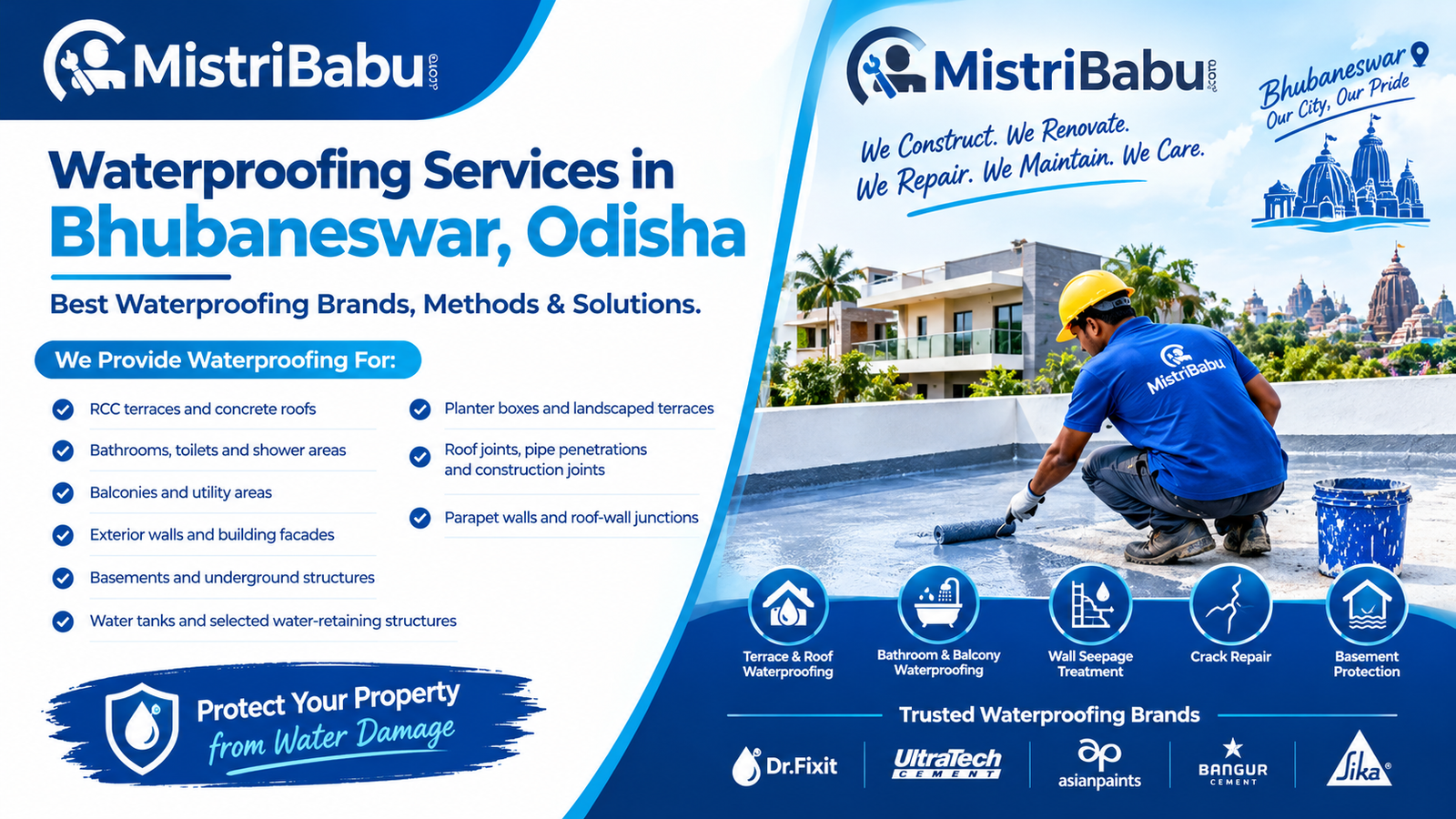
Bhubaneswar, the capital city of Odisha, experiences heavy monsoon rainfall, high humidity, hot summers and seasonal weather changes. These conditions can expose residential buildings, apartments, villas, duplexes, commercial properties and institutional buildings to water leakage, damp walls, terrace seepage, bathroom leakage and exterior wall deterioration.
Waterproofing is an essential part of building maintenance because it helps prevent unwanted water penetration, protects concrete and masonry, reduces dampness and supports the long-term durability of a property.
If you notice peeling paint, bubbling putty, black patches, white salt deposits, ceiling stains, damp plaster or water dripping from the roof, the underlying cause may be water ingress. Simply repainting the affected area will not solve the problem if the source of moisture remains untreated.
Professional waterproofing in Bhubaneswar, Odisha, should begin with identifying the source of leakage, preparing the affected surface, selecting a suitable waterproofing system and following the manufacturer's application instructions.
For service details, inspection and waterproofing solutions, visit the Waterproofing Services in Bhubaneswar page.
What Is Waterproofing?
Waterproofing is the process of protecting a building or structure against water penetration by using suitable membranes, coatings, sealants, cementitious systems, crystalline treatments or other approved waterproofing materials.
The correct method depends on the location of the problem, the condition of the substrate, the direction of water pressure, existing cracks, drainage arrangements and the type of construction.
Waterproofing is commonly required for:
RCC terraces and concrete roofs
Bathrooms, toilets and shower areas
Balconies and utility areas
Exterior walls and building facades
Basements and underground structures
Water tanks and selected water-retaining structures
Planter boxes and landscaped terraces
Roof joints, pipe penetrations and construction joints
Parapet walls and roof-wall junctions
Common Waterproofing Problems in Bhubaneswar
1. Terrace and Roof Leakage
Terraces and flat RCC roofs are directly exposed to rainfall, sunlight and temperature changes. Damaged waterproofing layers, cracks, poor drainage, defective joints and water stagnation can allow moisture to enter the building.
Recommended approach: Inspect the roof slab, drainage outlets, parapet junctions and existing coating. Repair cracks and defective details before applying a compatible waterproofing system.
2. Bathroom and Toilet Leakage
Water can escape through damaged tile joints, pipe penetrations, floor-wall junctions, defective plumbing or missing and damaged waterproofing beneath tiles. This can lead to damp ceilings, peeling paint and damage to neighbouring rooms.
Recommended approach: Check plumbing first. Where the concealed waterproofing layer has failed, tile removal and reapplication of a suitable waterproofing system may be necessary.
3. Wall Seepage and Dampness
Damp walls can result from rainwater penetration, leaking pipes, roof junctions, cracks, rising damp or moisture trapped within the wall. Symptoms include peeling paint, blistered putty, musty smells, mould growth and powdery salt deposits.
Recommended approach: Identify the source before removing loose paint and damaged plaster. Treat the cause of moisture and allow the substrate to dry appropriately before restoring the finish.
4. Exterior Wall Leakage
Exterior walls are exposed to rain, wind, sunlight and weathering. Cracks around windows, balconies, service openings and wall joints can become entry points for water.
Recommended approach: Repair compatible exterior-grade crack treatments, defective joints and surface damage. Apply a suitable breathable or elastomeric exterior coating when appropriate for the substrate and exposure.
5. Balcony and Utility-Area Leakage
Balconies may leak because of insufficient slope, blocked drainage outlets, failed waterproofing, cracked tile joints or poor sealing around railings and door thresholds.
Recommended approach: Check drainage, slope, waterproofing continuity and the junction between the balcony and the adjoining wall or door.
6. Basement and Foundation Dampness
Underground walls can experience moisture ingress from surrounding soil, groundwater and inadequate drainage. The correct solution depends on whether the structure is affected by damp soil, lateral water penetration or hydrostatic pressure.
Recommended approach: Assess drainage, foundation conditions and water pressure. Basement waterproofing may require external membranes, drainage systems, injection treatments or internal systems designed for the specific conditions.
Best Waterproofing Brands in India
Selecting a suitable waterproofing brand is important, but the product category, compatibility, surface preparation, application quality and warranty conditions matter just as much as the brand name.
The following are established brands to consider for different waterproofing requirements:
1. Dr. Fixit — Pidilite
Dr. Fixit offers a broad range of construction waterproofing products for roofs, terraces, bathrooms, walls and other building applications. Product selection should be based on the specific surface and leakage problem.
Suitable applications: Residential roof waterproofing, bathrooms, damp-wall treatment and selected exterior waterproofing systems.
2. Sika
Sika provides construction chemicals and waterproofing systems for residential, commercial and industrial structures. Depending on the product range available, options may include liquid-applied membranes, cementitious systems, joint sealants and concrete protection solutions.
Suitable applications: Concrete roofs, bathrooms, structural joints and selected specialised waterproofing projects.
3. Fosroc
Fosroc offers construction chemicals and systems used for concrete protection, waterproofing, joint treatment and repair.
Suitable applications: Concrete structures, basements, water-retaining structures and selected commercial projects.
4. Asian Paints SmartCare
Asian Paints SmartCare offers waterproofing solutions for various building surfaces, including roofs, terraces and exterior walls.
Suitable applications: Residential terrace protection, exterior wall waterproofing and selected roof coating applications.
5. MYK Arment
MYK Arment provides construction chemical products for waterproofing, tile installation, grouting and related building applications.
Suitable applications: Bathrooms, tiled surfaces, concrete structures and selected renovation projects.
Which is the best waterproofing brand?
There is no single brand that is best for every situation. For a residential terrace, a suitable roof membrane or coating may be appropriate; for a bathroom, a compatible under-tile waterproofing system is generally more relevant; and for a basement, a system designed for the actual water-pressure conditions may be required.
Always verify the latest product technical data sheet, approved application areas, coverage, number of coats, curing requirements and warranty terms before selecting a product.
Types of Waterproofing Services in Bhubaneswar
Roof and Terrace Waterproofing
Roof waterproofing helps protect the concrete slab against rainfall and moisture penetration. Available systems may include liquid-applied membranes, polymer-modified cementitious coatings, polyurethane systems and other compatible roof membranes.
The surface must be assessed for cracks, loose coatings, drainage problems and water stagnation. A coating should not be treated as a substitute for correcting major structural defects or inadequate drainage.
Bathroom Waterproofing
Bathroom waterproofing is particularly important during new construction and complete renovation. The waterproofing layer should be compatible with the tile adhesive, screed and final finish.
Key work areas include the shower zone, floor-wall junctions, pipe penetrations and other vulnerable details. Flood testing should be carried out where appropriate and permitted by the system specifications.
Wall Seepage Waterproofing
Wall seepage treatment starts with identifying whether water comes from plumbing, external rain penetration, roof leakage, a neighbouring wet area or rising damp.
Loose paint, putty and damaged plaster may need removal after the moisture source is corrected. Applying putty or paint over a damp wall can lead to recurring blistering and peeling.
Exterior Wall Waterproofing
Exterior wall waterproofing may involve crack repair, joint sealing, compatible protective coatings or a suitable breathable water-repellent treatment. The correct approach depends on the wall material and the source of water entry.
Basement Waterproofing
Basement waterproofing requires a site-specific assessment. The solution may include external membranes, drainage improvements, joint treatment, injection grouting or other systems designed for the water conditions and structural details.
Water Tank Waterproofing
Water tanks require products specifically suitable for water-retaining structures. For drinking-water tanks, verify that the selected product is approved for the intended potable-water contact and follow the manufacturer's curing and flushing instructions.
Waterproofing Process: Step-by-Step
A reliable waterproofing project should follow a systematic process rather than simply covering the visible stain.
Step 1: Site Inspection
Inspect the affected area, surrounding walls, terrace, plumbing lines, drainage outlets and adjoining spaces. Record visible cracks, damp patches, loose coatings and likely water-entry points.
Step 2: Identify the Source
Determine whether the moisture is caused by rain penetration, plumbing leakage, defective waterproofing, poor drainage, condensation or rising damp. Where necessary, carry out appropriate diagnostic tests.
Step 3: Surface Preparation
Remove loose paint, deteriorated putty, weak plaster, dust and other unsuitable material from the work area. Depending on the system, mechanical cleaning and surface conditioning may be necessary.
Step 4: Crack and Joint Repair
Repair cracks, construction joints, pipe penetrations and wall-floor junctions using materials compatible with the selected waterproofing system. Structural cracks require appropriate professional assessment.
Step 5: Apply Waterproofing Material
Apply the selected primer, membrane, coating or cementitious system according to its technical data sheet. Observe the specified coverage, coat thickness, reinforcement, recoat intervals and curing requirements.
Step 6: Testing and Quality Inspection
Where appropriate, conduct a controlled ponding or flood test, inspect vulnerable junctions and verify drainage performance. Not all systems or surfaces can be tested in the same way, so follow the product and project specifications.
Step 7: Final Restoration
After the waterproofing system has cured and passed the required checks, complete the specified screed, tile, plaster or paint work. Ensure that finishing materials are compatible with the waterproofing layer.
Why Should Paint and Putty Be Removed Before Waterproofing?
When paint or putty is loose, blistered, powdery or affected by moisture, it can prevent a waterproofing treatment from bonding properly to the underlying surface.
Removing deteriorated layers helps expose the substrate, identify cracks and reveal areas requiring repair. However, the extent of removal should be based on the condition of the surface and the requirements of the chosen waterproofing system.
Important points to remember:
Remove loose and flaking paint from affected surfaces.
Remove weak, blistered or moisture-damaged putty where required.
Remove deteriorated plaster when it no longer provides a sound base.
Repair the source of water entry before applying new decorative finishes.
Allow appropriate drying and curing time before repainting.
Do not cover active seepage with fresh putty or paint alone.
For property owners dealing with damp patches or recurring leakage, professional assessment can help determine whether the problem requires roof treatment, exterior wall protection, plumbing repair or a more extensive waterproofing solution.
Explore Waterproofing Services in Bhubaneswar to learn more about available service options.
Waterproofing Cost in Bhubaneswar, Odisha
The cost of waterproofing depends on the affected area, access conditions, existing surface condition, material system, number of coats, repair requirements and whether tiles, plaster or old coatings need removal.
A proper quotation should specify the treatment area, surface preparation, material brand and product, application method, testing, finishing work, taxes and warranty conditions.
The following table describes the main cost factors rather than fixed market prices.
| Work category | Factors affecting cost |
|---|---|
| Terrace waterproofing | Roof area, cracks, drainage and membrane type |
| Bathroom waterproofing | Tile removal, plumbing repairs and concealed-layer condition |
| Wall seepage treatment | Paint and plaster removal, source of moisture and restoration |
| Exterior wall waterproofing | Building height, access equipment and coating system |
| Basement waterproofing | Water pressure, excavation access and drainage requirements |
| Water tank waterproofing | Tank condition, approved materials and preparation requirements |
For an accurate estimate, arrange an inspection and request a written scope of work. Extremely low quotations may exclude essential preparation, crack treatment, testing or restoration.
Areas Covered for Waterproofing in Bhubaneswar
Waterproofing requirements vary across apartments, independent houses, villas, duplexes, commercial buildings and older properties. Service availability should be confirmed for the exact location and project.
Central Bhubaneswar
Ashok Nagar
Master Canteen
Unit 1
Unit 2
Unit 3
Unit 4
Unit 5
Unit 6
Unit 7
Unit 8
Unit 9
Unit 10
Unit 11
Bapuji Nagar
Bhauma Nagar
Kharavela Nagar
Saheed Nagar
Satya Nagar
Ram Mandir Square
Rajmahal Square
Kalpana Square
Old Station Bazaar
Market Building
Forest Park
Ganga Nagar
Keshari Nagar
Ekamra Vihar
AG Colony
BJB Nagar
Lewis Road
Ravi Talkies area
North and Northeast Bhubaneswar
Chandrasekharpur
Sailashree Vihar
Niladri Vihar
Damana
Patia
KIIT area
KIIT Square
Infocity
Infocity Road
Kanan Vihar
District Centre
Rail Vihar
Maitree Vihar
VSS Nagar
Sainik School area
Mancheswar
Rasulgarh
Vani Vihar
Acharya Vihar
Jaydev Vihar
Doordarshan Kendra area
Raghunathpur
Nandan Vihar
Kalarahanga
Khandagiri Square-side extensions
West Bhubaneswar
Nayapalli
IRC Village
Behera Sahi
Indradhanu Market area
CRP Square
Baramunda
Baramunda Housing Board Colony
Baramunda Bus Stand area
Dumduma
Jagamara
Khandagiri
Pokhariput
Ghatikia
Shankarpur
Soubhagya Nagar
Nuagaon
Aiginia
Patrapada
Tamando
Gothapatna
Chandaka
Daspur
Bharatpur
Biju Patnaik Energy Park area
South Bhubaneswar and Old Town
Old Town
Lingaraj Temple area
Bindusagar area
Ratha Road
Garage Chhak
Samantarapur
Badagada
Brahmeswar Patna
Sisupalgarh
Sundarpada
Kapilaprasad
Pandra
Lingipur
Balianta-side residential areas
Tankapani Road
Gouri Nagar
Jharpada
Bomikhal
Lakshmi Sagar
Cuttack Road
Bhimatangi
Satyabhama Pur-side outskirts
Eastern and Peripheral Bhubaneswar
Hanspal
Pahal
Rasulgarh industrial area
Palasuni
Naharkanta
Balianta
Kalinga Nagar
Shampur
Madanpur
Gothapatna outskirts
Chandaka Industrial Estate
Janla
Retang
Khurda Road-side residential areas
Jatni-side outskirts
Phulnakhara
Nakhara
Kalarahanga outskirts
Barang-side areas
Coverage note: This is a broad list of localities and surrounding residential areas, not a guarantee that every neighbourhood or peripheral village falls within a particular service team's coverage. Confirm availability and travel charges for the specific property address.
Waterproofing for Different Types of Properties
Independent Houses and Duplexes
Independent houses and duplexes may require terrace waterproofing, parapet protection, bathroom treatment, exterior wall crack repair and balcony waterproofing.
Apartments and Residential Societies
Apartment waterproofing can involve terrace slabs, common-area toilets, service shafts, balconies, external walls and overhead water tanks. Coordinating with the building association may be necessary.
Commercial Buildings and Offices
Commercial properties may need roof protection, basement waterproofing, washroom treatment, external facade maintenance and leakage investigation to minimise disruption to daily operations.
New Construction Projects
In new construction, waterproofing should be planned before tile installation, plastering or other finishes conceal the underlying layers. Proper detailing around pipes, corners, joints and outlets is especially important.
Common Waterproofing Mistakes to Avoid
Painting over damp walls without identifying the source of moisture.
Applying waterproofing material over loose paint, dusty concrete or weak plaster.
Ignoring roof drainage, blocked outlets and water stagnation.
Using exterior wall paint as a substitute for a proper waterproofing membrane.
Applying bathroom waterproofing without treating pipe penetrations and wall-floor junctions.
Ignoring cracks or assuming every crack is cosmetic.
Applying a new coating over an incompatible old waterproofing layer.
Skipping required curing time or testing.
Assuming every waterproofing product is suitable for drinking-water tanks.
Accepting a quotation without a clear scope, product specification and written warranty terms.
How to Choose a Waterproofing Contractor in Bhubaneswar
Before appointing a waterproofing contractor, consider the following:
Ask for a site inspection and explanation of the likely moisture source.
Request a written quotation with a clear scope of work.
Check the proposed product brand, product name and technical data sheet.
Confirm the method of surface preparation and crack repair.
Ask whether testing is included and how it will be performed.
Clarify whether plaster, putty, paint, tiles and debris removal are included.
Obtain written warranty terms, exclusions and maintenance requirements.
Confirm whether scaffolding, access equipment and additional repairs are charged separately.
A reliable contractor should explain why a particular system is recommended rather than offering the same coating for every type of leakage.
FAQs- Waterproofing in Bhubaneswar
1. Which is the best waterproofing solution for a terrace in Bhubaneswar?
The best solution depends on the roof condition, existing coating, water stagnation, cracks and drainage. Suitable options may include liquid-applied membranes or other compatible roof waterproofing systems.
2. Which waterproofing brand is best in Odisha?
Dr. Fixit, Sika, Fosroc, Asian Paints SmartCare and MYK Arment are established brands to consider. The correct product for the specific application is more important than choosing a brand name alone.
3. Can wall seepage be fixed by repainting?
Repainting alone will not resolve active seepage. The source of moisture must be identified and corrected, and damaged paint or plaster should be restored only when the surface is suitably dry and prepared.
4. Is it necessary to remove paint and putty before waterproofing?
Loose, blistered or moisture-damaged paint and putty generally need to be removed where they interfere with adhesion or conceal damage. The precise preparation depends on the selected waterproofing system.
5. How long does waterproofing last?
Service life depends on the product, substrate preparation, application quality, weather exposure, drainage, movement and maintenance. Follow the manufacturer's product-specific guidance and warranty conditions.
6. Can waterproofing be done during the monsoon?
Some work may be possible during suitable dry periods, but many products require dry surfaces and protection from rain during application and curing. Follow the product instructions and site conditions.
7. Does bathroom waterproofing require tile removal?
Not always. If the concealed waterproofing layer has failed, removing the tiles may be necessary to install a new system correctly. Surface-level treatments cannot reliably replace a failed under-tile membrane in every situation.
8. How can I identify terrace leakage?
Common signs include ceiling stains, damp patches below the roof, peeling paint, cracks, water accumulation on the terrace and leakage after rainfall. A site inspection is needed to confirm the cause.
9. Is waterproofing necessary for a new house?
Yes. Properly designed waterproofing in bathrooms, terraces, balconies, water tanks and other vulnerable areas helps protect the building before finishes are installed.
10. Where can I find waterproofing services in Bhubaneswar?
You can review Waterproofing Services in Bhubaneswar, Odisha for service information and to enquire about the appropriate solution for your property.
Conclusion
Waterproofing is an important part of protecting residential and commercial properties in Bhubaneswar, Odisha. Heavy rainfall, humid conditions, ageing coatings, defective joints and plumbing leaks can contribute to roof leakage, bathroom seepage, damp walls and exterior deterioration.
The right approach begins with identifying the cause, preparing the surface correctly, selecting a compatible waterproofing system and completing the required inspection and testing. Choosing an established waterproofing brand, following technical instructions and obtaining a clear written scope can help reduce recurring leakage and unnecessary repair expenses.
Whether you need terrace waterproofing, bathroom waterproofing, exterior wall protection, basement treatment or damp-wall repair, select a solution based on the actual condition of your building.
Need waterproofing assistance in Bhubaneswar? Visit the Waterproofing Services in Bhubaneswar, Odisha page to learn more and enquire about a suitable waterproofing solution for your property.
Protect your property from water damage with proper inspection, reliable materials and professional waterproofing workmanship.

MistriBabu
Admin