
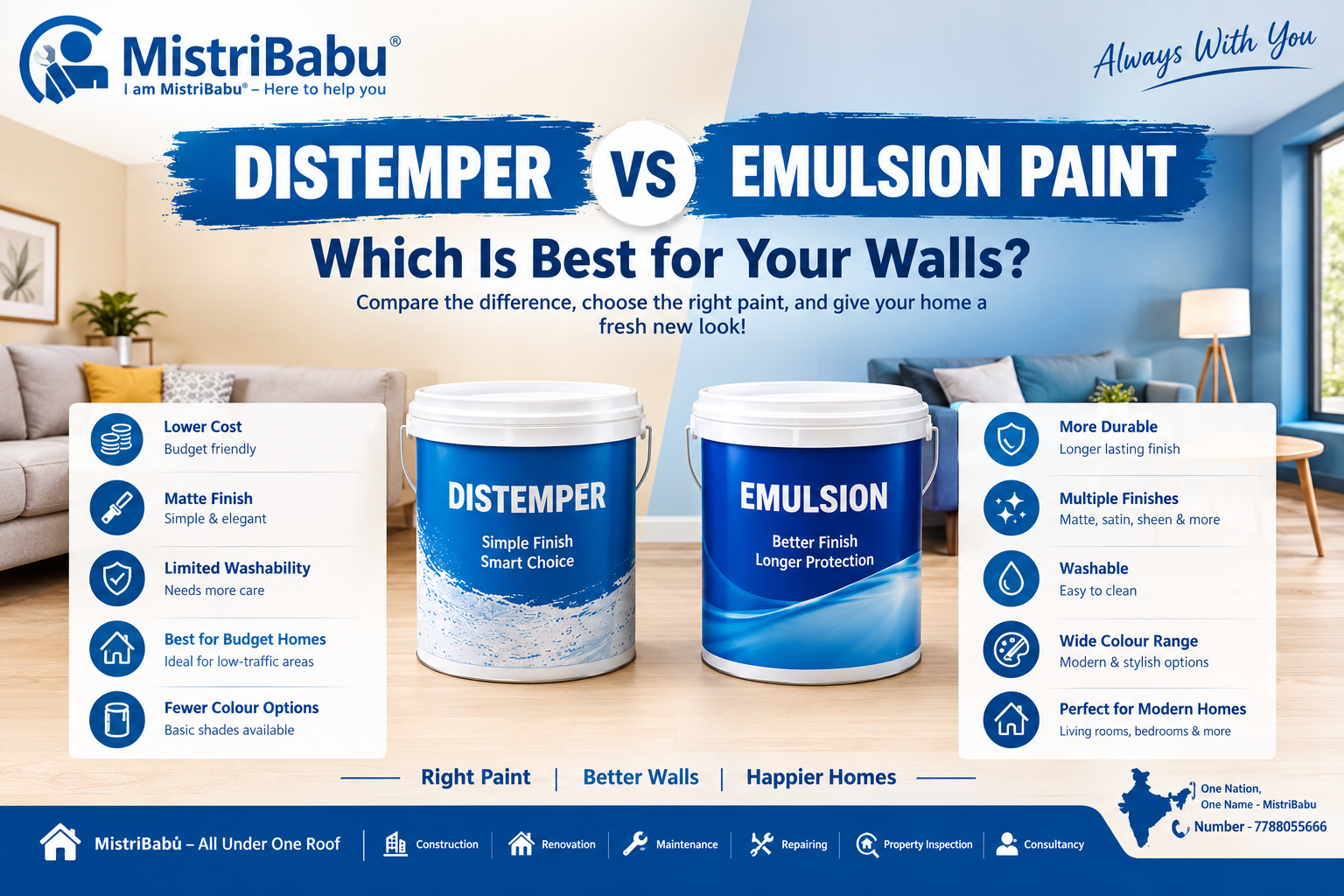
Distemper vs Emulsion Paint: Which Is Best for Your Walls? This is one of the most common questions homeowners ask when planning a new house, repainting an old property, renovating an apartment, or choosing a budget-friendly wall finish. Both distemper and emulsion paint are popular choices in India, but they differ in durability, appearance, washability, maintenance, application, and overall cost.
Distemper is generally chosen for economical interior wall painting, rental properties, and projects where initial cost is a priority. Emulsion paint is often preferred for modern homes, premium interiors, bedrooms, living rooms, and spaces where a smoother finish, greater durability, and easier cleaning are important.
Choosing the right paint depends on your budget, wall condition, location, climate, moisture exposure, and long-term maintenance expectations.
At MistriBabu® – India’s Trusted Construction, Renovation, Maintenance & Repair Services Brand, we help homeowners understand painting options and plan complete painting projects according to their requirements. Whether you are painting a new home, refreshing an existing property, or renovating an apartment, understanding the difference between distemper and emulsion paint can help you make an informed decision.
Table of Contents
What Is Distemper Paint?
What Is Emulsion Paint?
Distemper vs Emulsion Paint: Key Differences
Distemper vs Emulsion Paint: Which Is Better?
Types of Distemper Paint
Types of Emulsion Paint
Distemper vs Emulsion Paint: Cost in India
Which Paint Is Best for Each Room?
Which Paint Is Better for Different Indian Climates?
Advantages and Disadvantages of Distemper
Advantages and Disadvantages of Emulsion
Wall Preparation and Painting Process
Common Painting Mistakes to Avoid
How to Choose the Right Wall Paint
Distemper vs Emulsion Paint FAQs
Painting Services Across India
Conclusion
1. What Is Distemper Paint?
Distemper is a traditional, economical wall coating used mainly on interior plastered walls and ceilings. Modern distemper products may use different binders and formulations, including acrylic-based formulations, while traditional products can have a chalkier, less washable finish.
Distemper is commonly selected for homes where the owner wants a simple, clean appearance without spending heavily on decorative wall finishes.
Key features of distemper paint
Generally economical compared with many premium emulsion products.
Available in a variety of colours and shades.
Suitable for many interior walls and ceilings when the product is appropriate for the surface.
Usually offers a simpler finish than premium emulsions.
May be less resistant to repeated washing, stains, and abrasion, depending on the formulation.
Can require more frequent repainting in high-use areas.
Where is distemper paint suitable?
Distemper may be suitable for:
Budget-conscious residential projects.
Rental homes and low-maintenance decorative upgrades.
Interior ceilings and selected low-traffic rooms.
Properties where a basic painted finish is sufficient.
Important: Always check the product label. Not every distemper product has the same performance, and application requirements vary by manufacturer.
2. What Is Emulsion Paint?
Emulsion paint is a water-based paint commonly used for modern residential and commercial interiors. It typically contains pigments, binders, water, and other ingredients that help provide colour, coverage, adhesion, and surface protection.
Interior emulsions are available in different grades, including economy, mid-range, premium, and luxury products. Exterior emulsions are specially formulated for outdoor exposure and should not automatically be treated as equivalent to interior paints.
Compared with traditional distemper, a suitable quality emulsion can offer a smoother finish, better stain resistance, and easier cleaning.
Key features of emulsion paint
Available in matte, soft-sheen, satin, and other finishes, depending on the product.
Generally offers better washability in grades specifically designed for cleaning.
Often provides better resistance to everyday marks and abrasion than traditional distemper.
Available in a broad range of colours and decorative finishes.
Suitable for living rooms, bedrooms, hallways, and other frequently used spaces.
Premium products may offer improved stain resistance and longer service life under suitable conditions.
Where is emulsion paint suitable?
Emulsion paint is commonly used for:
Living rooms and bedrooms.
Apartments and independent houses.
New residential construction.
Renovation and repainting projects.
Offices, showrooms, and selected commercial interiors.
Exterior walls when an appropriate exterior-grade product is selected.
Remember: Emulsion is a broad product category. An economy emulsion may not perform like a premium washable emulsion. Always compare the specific product's technical specifications rather than relying on the word “emulsion” alone.
3. Distemper vs Emulsion Paint: Key Differences
| Comparison factor | Distemper paint | Emulsion paint |
|---|---|---|
| Initial cost | Usually lower | Usually higher, depending on grade |
| Appearance | Generally simple, often matte | Available in various finishes |
| Washability | Often limited; product-dependent | Generally better in washable grades |
| Stain resistance | Usually limited in traditional products | Often better in suitable premium grades |
| Durability | Often lower in demanding conditions | Often higher with suitable preparation |
| Maintenance | May need more frequent repainting | Can be easier to clean and maintain |
| Colour options | Available in many shades | Wide range of shades and finishes |
| Surface preparation | Depends on product and wall condition | Proper preparation is essential |
| Best use | Budget-conscious interior applications | Modern homes and frequently used spaces |
| Long-term value | Can be economical for basic needs | May offer better value over time |
| Moisture resistance | Not a substitute for waterproofing | Product-dependent; not a cure for damp walls |
| Exterior use | Only where the product specifically permits it | Use a purpose-made exterior emulsion |
The exact performance depends on the formulation, brand, surface preparation, application method, environmental conditions, and maintenance.
4. Distemper vs Emulsion Paint: Which Is Better?
There is no single answer for every property. The best option depends on what matters most to you.
Choose distemper if:
Your budget is limited.
You need a basic interior wall finish.
The property is a rental or temporary-use space.
The walls do not require frequent cleaning.
You are comfortable with potentially more frequent repainting.
Choose emulsion if:
You want a more refined decorative finish.
Your living room or bedroom receives frequent use.
You want easier cleaning from a suitably washable product.
You prefer a wider choice of finishes.
You want to consider long-term maintenance costs rather than only the initial expense.
Our recommendation
For most modern owner-occupied homes, a good-quality interior emulsion is a practical choice for living rooms, bedrooms, passages, and other frequently used spaces. For basic, budget-sensitive interiors, suitable distemper can still be a reasonable option.
For kitchens and areas exposed to frequent splashes, choose a paint specifically designed for the conditions. For bathrooms and persistently damp walls, first address the moisture source and select a suitable coating system.
5. Types of Distemper Paint
A. Dry distemper
Dry distemper is a traditional, economical product that is mixed with water according to the manufacturer's instructions. It is generally associated with a basic matte finish.
Best for: Selected budget interior applications where the product is suitable for the substrate.
B. Oil-bound distemper
Oil-bound distemper generally offers a more binder-rich formulation than traditional dry distemper. Its characteristics depend on the specific product.
Best for: Interior wall applications permitted by the manufacturer.
C. Acrylic distemper
Acrylic distemper uses an acrylic-based binder and may offer improved adhesion or durability compared with traditional formulations. Performance varies significantly by brand and grade.
Best for: Budget-conscious interiors where a conventional distemper finish is preferred.
6. Types of Emulsion Paint
A. Economy emulsion
A lower-cost emulsion intended for basic decorative painting. Coverage, finish, washability, and durability depend on the product.
B. Premium emulsion
A higher-grade option that may provide better finish consistency, washability, and resistance to everyday marks.
C. Luxury emulsion
A premium decorative category that may offer enhanced finish quality, stain resistance, colour depth, or other features. The actual benefits depend on the manufacturer's specifications.
D. Matte emulsion
Provides a low-sheen finish that can help make minor surface irregularities less noticeable.
E. Sheen or satin-finish emulsion
Provides more surface reflectivity than matte finishes. It may be easier to clean in some formulations, but the finish can highlight uneven wall preparation.
F. Exterior emulsion
Designed for outdoor walls and formulated for weather exposure. Choose a product suitable for the local climate and the building substrate.
Important: Interior paint should not be substituted for exterior paint simply to reduce cost. Select the correct coating for the intended application.
7. Distemper vs Emulsion Paint: Cost in India
Painting cost varies across India depending on the city, product brand, paint grade, wall condition, labour charges, accessibility, number of coats, and whether primer, putty, sanding, crack repair, or old-paint removal is required.
The following figures are indicative budgeting ranges, not verified live quotations or fixed market rates. Confirm the current product price and local execution cost before finalising a project.
| Painting category | Indicative cost per sq. ft. |
|---|---|
| Distemper painting | ₹8–₹18 |
| Economy emulsion painting | ₹12–₹25 |
| Premium emulsion painting | ₹18–₹35 |
| Luxury emulsion painting | ₹25–₹50+ |
These illustrative ranges may vary widely by location and specification. They should not be used as a final quotation without a site assessment.
What can affect the total cost?
Paint brand and grade: Economy and premium products have different prices.
Wall condition: Cracks, flaking paint, dampness, and uneven plaster can increase preparation costs.
Putty and primer: The number of coats and the selected products affect the total.
Number of coats: Additional coats may be required for coverage or colour changes.
Labour and access: Ceiling height, furniture, occupied rooms, scaffolding, and protection work can affect labour charges.
Location: Rates may differ between metropolitan areas, smaller cities, and remote locations.
Taxes and additional work: Confirm whether applicable taxes and ancillary work are included.
How to compare quotations fairly
Ask each contractor to specify:
Paint brand, exact product name, and grade.
Primer and putty specifications.
Number of coats.
Surface preparation included.
Whether material and labour are included.
Whether furniture protection and cleanup are included.
Applicable taxes, exclusions, and quotation validity.
A lower initial price is not necessarily the lowest total cost over the life of the paint.
8. Which Paint Is Best for Each Room?
| Area | Suggested option | Why |
|---|---|---|
| Living room | Good-quality interior emulsion | Decorative finish and easier maintenance |
| Master bedroom | Matte or suitable premium emulsion | Comfortable, refined appearance |
| Children's bedroom | Washable emulsion | Helps with cleaning everyday marks |
| Guest bedroom | Economy or premium emulsion | Depends on budget and use |
| Ceiling | Suitable ceiling paint or approved distemper | Depends on the desired finish and product suitability |
| Staircase and passage | Durable, washable emulsion | Frequent contact and marks |
| Kitchen | Suitable washable interior coating | Better suited to routine cleaning |
| Bathroom | Moisture-appropriate coating on a suitable substrate | Must be paired with correct moisture control |
| Rental property | Distemper or economy emulsion | Depends on rental budget and expected maintenance |
| Exterior wall | Purpose-made exterior paint | Designed for outdoor weather exposure |
The room-wise suggestions are general guidance. Product specifications and actual wall conditions should determine the final choice.
9. Which Paint Is Better for Different Indian Climates?
India has diverse climates, from humid coastal regions to hot, dry interiors, cold mountain areas, and regions with heavy monsoon rainfall. Climate should influence surface preparation and product selection.
Hot and dry regions
In areas with intense heat and dust, choose a coating suitable for the substrate and local conditions. Good surface preparation helps reduce premature paint failure.
Humid and coastal regions
In coastal and humid locations, moisture management is essential. Check for seepage, condensation, salt deposits, and fungal growth before painting. Select a suitable coating system after the cause of moisture has been addressed.
Heavy monsoon regions
Inspect exterior walls, roof junctions, balconies, window edges, and plumbing lines for water ingress. No interior paint can compensate for unresolved leakage.
Cold and mountainous regions
Follow the manufacturer's permitted application temperature and humidity limits. Allow sufficient drying time between coats.
Key principle: Climate alone does not determine whether distemper or emulsion is best. The wall substrate, moisture conditions, paint formulation, and quality of application are equally important.
10. Advantages and Disadvantages of Distemper Paint
Advantages
Often economical for basic painting requirements.
Suitable for selected interior walls and ceilings.
Available in a variety of colours.
Can be appropriate for low-use spaces.
May suit projects where the owner prioritises initial cost.
Disadvantages
Traditional formulations may not tolerate frequent washing.
Can be less suitable for high-traffic interiors.
May require repainting sooner in demanding conditions.
Usually offers fewer premium decorative options than modern emulsion ranges.
Does not solve dampness, leakage, or plaster defects.
11. Advantages and Disadvantages of Emulsion Paint
Advantages
Available in a wide range of finishes and product grades.
Suitable washable grades can be easier to maintain.
Often provides a refined finish for modern interiors.
Premium options may offer improved stain resistance.
Can provide better long-term value when durability and maintenance are considered.
Disadvantages
Initial material costs can be higher.
Premium products may increase the total project budget.
Glossier finishes can reveal surface imperfections.
Proper preparation is essential for good results.
Performance varies by product; not every emulsion is highly washable or moisture-resistant.
12. Wall Preparation and Painting Process
A professional painting job is not just about applying paint. Proper preparation is essential for appearance, adhesion, and durability.
Step 1: Inspect the walls
Check for damp patches, cracks, peeling paint, chalking, fungal growth, and loose plaster. Resolve water leakage and structural or substrate issues before decorative painting.
Step 2: Prepare the surface
Remove loose or flaking paint and clean dust, grease, and other contaminants using an appropriate method. Allow the surface to dry as required.
Step 3: Repair cracks and imperfections
Repair suitable surface defects with compatible materials. Significant cracks, recurring dampness, or structural cracks require further investigation rather than simply filling and painting over them.
Step 4: Apply primer where specified
Use a compatible primer according to the chosen paint system and manufacturer's instructions.
Step 5: Apply putty if required
Wall putty can help create a smoother finish when used on a suitable surface. Apply it only as directed for the substrate and paint system, then sand appropriately after drying.
Step 6: Apply the selected paint
Apply distemper or emulsion in the recommended number of coats, observing dilution instructions and drying times.
Step 7: Inspect the finished work
Check colour consistency, coverage, edges, corners, roller marks, and visible defects under appropriate lighting. Complete necessary touch-ups and clean the work area.
Step 8: Allow proper curing and ventilation
Follow the product instructions for drying, recoating, room use, and ventilation. Keep the area ventilated and follow all safety directions.
13. Common Painting Mistakes to Avoid
Selecting paint only by the lowest price.
Applying paint over damp or contaminated walls.
Ignoring cracks, seepage, and peeling plaster.
Using the wrong primer for the surface.
Skipping required preparation.
Applying the next coat before the previous coat is ready.
Over-diluting the paint.
Choosing interior paint for exterior exposure.
Comparing quotations without checking the number of coats and materials.
Assuming all emulsion paints have the same washability and durability.
14. How to Choose the Right Wall Paint
Before making a final decision, answer these five questions:
1. What is your budget?
Distemper may suit a limited budget. Economy, premium, or luxury emulsion can be considered according to your priorities.
2. Is the property owner-occupied or rented?
A long-term home may justify investing in a more durable coating, while a rental property may require a different cost-maintenance balance.
3. Do you need washable walls?
Choose a product with a clearly stated washability or scrub-resistance specification if frequent cleaning is important.
4. What condition are the walls in?
Dampness, cracks, and peeling must be addressed before choosing the decorative finish.
5. How long do you expect the finish to last?
Compare the initial cost with the expected maintenance and repainting requirements. Actual service life depends on the product, preparation, exposure, and usage.
Final buying tip
Compare the complete painting system, not just the price of a paint bucket. Primer, putty, surface preparation, labour, number of coats, and the quality of application all contribute to the finished result.
15. Distemper vs Emulsion Paint: Frequently Asked Questions
Q1. Which is better, distemper or emulsion paint?
Emulsion is generally the better choice for modern homes where finish quality, washability, and maintenance are important. Distemper may be suitable for basic interior painting where initial cost is the main priority.
Q2. Which paint is cheaper in India?
Distemper is generally cheaper initially than many emulsion products. The exact cost depends on the brand, grade, location, preparation, labour, and number of coats.
Q3. Is distemper paint washable?
Traditional distemper is often not suitable for repeated washing. Some modern formulations may offer improved performance, so check the specific product's technical data.
Q4. Is emulsion paint waterproof?
Ordinary interior emulsion should not be considered a waterproofing treatment. Water ingress and dampness must be addressed with an appropriate repair or waterproofing system before painting.
Q5. Can emulsion paint be applied over distemper?
It may be possible if the existing coating is sound and compatible with the new paint system. Loose, powdery, peeling, or poorly bonded distemper should be removed or treated as specified by the manufacturer. A site assessment and suitable preparation are recommended.
Q6. Can distemper be applied over emulsion paint?
Do not assume compatibility. The existing surface must be stable, clean, and suitable for the selected product. Follow the distemper manufacturer's instructions and prepare the surface accordingly.
Q7. Which paint is best for a new house?
For most modern residential interiors, a suitable interior emulsion is a common choice. The correct primer, surface preparation, and curing of plaster are important before application.
Q8. Which paint is best for a rental house?
Distemper or economy emulsion may be appropriate, depending on the owner's budget, tenant usage, and expected maintenance. Economy emulsion may offer a useful balance where cleaning is important.
Q9. Which paint is best for a living room?
A good-quality interior emulsion is often preferred because of its finish and available colour choices. Select matte or another finish according to the wall condition and desired appearance.
Q10. Which paint is best for bedrooms?
Matte or suitable washable emulsion is a practical option for most bedrooms. The choice depends on budget, cleaning requirements, and design preferences.
Q11. How many coats of paint are required?
The number of coats depends on the product, wall condition, colour change, primer system, and coverage requirements. Follow the manufacturer's instructions and assess the finished coverage.
Q12. Can paint hide wall cracks?
Paint can improve appearance but cannot reliably repair cracks. Repair the underlying defect using a suitable method before painting.
Q13. Why does wall paint peel?
Common causes include moisture, poor surface preparation, contamination, incompatible coatings, unsuitable application conditions, and inadequate drying. The root cause should be identified before repainting.
Q14. Does emulsion paint cost more in every city?
Not necessarily. Product pricing, availability, transport, labour, and preparation costs vary by location. Obtain a local quotation based on the same product specification and scope of work.
Q15. Does MistriBabu provide complete painting services?
MistriBabu's painting service scope should be confirmed for your location and current availability. Where the service is available, ask for a quotation covering materials, surface preparation, primer, putty if required, paint coats, labour, and exclusions.
16. Painting Services Across India – MistriBabu®
MistriBabu® supports customers looking for construction, renovation, maintenance, repair, and painting solutions, subject to location-specific service availability.
For distemper and emulsion painting, the appropriate paint system depends on the wall condition, building type, budget, climate, and desired finish. Before starting work, confirm the service location, current availability, material specifications, and quotation.
States and Union Territories of India
MistriBabu's potential nationwide service-area content can reference all 28 states and 8 Union Territories listed below. This is a geographic coverage list, not a guarantee that painting services are currently available in every listed location. Confirm availability before booking.
28 States
Andhra Pradesh
Arunachal Pradesh
Assam
Bihar
Chhattisgarh
Goa
Gujarat
Haryana
Himachal Pradesh
Jharkhand
Karnataka
Kerala
Madhya Pradesh
Maharashtra
Manipur
Meghalaya
Mizoram
Nagaland
Odisha
Punjab
Rajasthan
Sikkim
Tamil Nadu
Telangana
Tripura
Uttar Pradesh
Uttarakhand
West Bengal
8 Union Territories
Andaman and Nicobar Islands
Chandigarh
Dadra and Nagar Haveli and Daman and Diu
Delhi (National Capital Territory)
Jammu and Kashmir
Ladakh
Lakshadweep
Puducherry
Major cities and service-area examples
Customers may enquire about painting requirements in major cities and urban regions, including:
Delhi NCR: Delhi, Noida, Greater Noida, Gurugram (Gurgaon), Faridabad and Ghaziabad.
Odisha: Bhubaneswar, Cuttack, Puri, Rourkela, Paradip, Kendrapara, Jagatsinghpur, Balasore, Sambalpur, Berhampur and Jajpur.
West Bengal: Kolkata, Howrah, Durgapur and Siliguri.
Maharashtra: Mumbai, Pune, Nagpur and Nashik.
Karnataka: Bengaluru (Bangalore), Mysuru and Mangaluru.
Telangana: Hyderabad and Warangal.
Tamil Nadu: Chennai, Coimbatore and Madurai.
Andhra Pradesh: Visakhapatnam, Vijayawada and Tirupati.
Kerala: Kochi, Thiruvananthapuram and Kozhikode.
Gujarat: Ahmedabad, Surat, Vadodara and Rajkot.
Rajasthan: Jaipur, Jodhpur, Udaipur and Kota.
Uttar Pradesh: Lucknow, Kanpur, Agra, Varanasi and Prayagraj.
Bihar: Patna, Gaya and Muzaffarpur.
Jharkhand: Ranchi, Jamshedpur and Dhanbad.
Chhattisgarh: Raipur, Bhilai and Bilaspur.
Madhya Pradesh: Bhopal, Indore, Jabalpur and Gwalior.
Punjab: Ludhiana, Amritsar, Jalandhar and Patiala.
Haryana: Karnal, Panipat, Hisar and Ambala.
Uttarakhand: Dehradun, Haridwar and Haldwani.
Himachal Pradesh: Shimla, Solan and Dharamshala.
Assam: Guwahati, Dibrugarh and Silchar.
Goa: Panaji, Margao and Vasco da Gama.
Other regions: Customers in the remaining states and Union Territories can enquire about service availability for their specific location.
The city list provides examples for geographic relevance. It should be expanded into individual location pages only when the business can support accurate, useful local information and the corresponding service is actually offered.
17. Conclusion: Distemper vs Emulsion Paint
Both distemper and emulsion paint have a place in residential painting. Distemper can be a practical, economical solution for basic interior requirements, while a suitable emulsion is often a better choice for modern homes where appearance, cleaning, and long-term maintenance matter.
Before choosing, compare the product grade, total painting cost, wall preparation, washability, and maintenance expectations. Most importantly, resolve dampness and wall defects before applying any decorative coating.

MistriBabu
Admin