
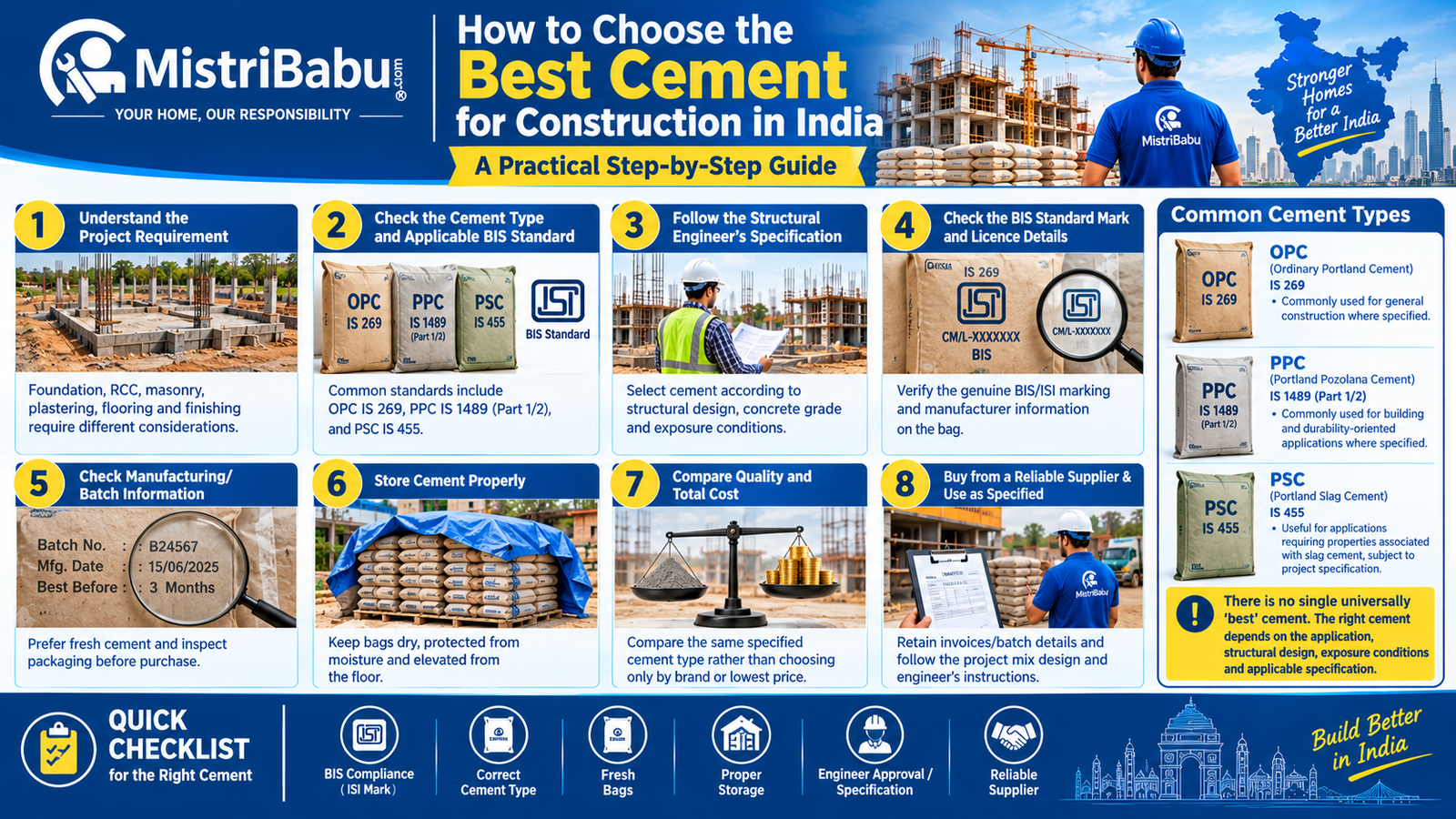
Choosing the right cement is one of the most important decisions in house construction, commercial construction, renovation and infrastructure projects. Cement directly affects concrete strength, durability, workability, setting behaviour and long-term performance.
However, there is no single cement type that is universally “best” for every project or every location in India. The correct choice depends on the structural requirement, exposure conditions, soil and groundwater conditions, climate, construction stage, concrete mix design and applicable Indian Standards.
The Bureau of Indian Standards (BIS) currently lists multiple cement standards, including OPC under IS 269, Portland Pozzolana Cement under IS 1489, Portland Slag Cement under IS 455, sulphate-resisting cement under IS 12330, low-heat cement under IS 12600, composite cement under IS 16415, and Portland calcined clay limestone cement under IS 18189.
1. Why Cement Selection Matters
Cement is a key binding material used in:
- House construction
- Villa construction
- Apartment construction
- Commercial buildings
- RCC structures
- Foundations
- Columns
- Beams
- Slabs
- Staircases
- Plastering
- Masonry
- Flooring
- Roads
- Bridges
- Water-retaining structures
- Marine and coastal structures
Selecting cement only because a particular brand is popular or inexpensive can be a mistake. The cement type, applicable IS standard, project specification and site conditions should be considered together.
2. Understand the Major Cement Types Used in India
OPC – Ordinary Portland Cement
OPC is covered by IS 269:2015. BIS documentation identifies OPC grades including OPC 33, OPC 43, OPC 53 and special variants such as 43S and 53S.
OPC is commonly considered where:
- Early strength is important
- RCC construction requires specified strength development
- Structural concrete specifications call for OPC
- Certain industrial or infrastructure applications require it
The grade should not be selected simply because a higher number sounds stronger. The required grade should be determined by the structural specification and concrete mix design.
PPC – Portland Pozzolana Cement
PPC is covered by IS 1489.
BIS recognises:
- IS 1489 Part 1 – Fly ash based PPC
- IS 1489 Part 2 – Calcined clay based PPC
PPC can be suitable for many general building applications and is also identified by BIS for applications including foundations, mass concrete, marine structures and other situations where OPC is used, except where specially high early strength is required.
PSC – Portland Slag Cement
PSC is covered under IS 455:2015.
It contains granulated slag within the limits specified by the standard. BIS identifies PSC for construction applications where its performance characteristics are appropriate.
PSC can be considered particularly where durability and exposure conditions are important, subject to project specifications and professional engineering advice.
Sulphate-Resisting Portland Cement
Sulphate-resisting cement is covered by IS 12330. BIS includes it among its cement standards.
It may be considered for projects where concrete is exposed to significant sulphate conditions, such as certain:
- Foundations
- Soil conditions
- Groundwater conditions
- Sewage-related structures
- Industrial environments
The requirement should be confirmed through site investigation and project specifications rather than selected solely on the basis of location.
3. Cement Selection According to Construction Work
| Construction Work | Cement Selection Consideration |
|---|---|
| RCC foundation | Project specification, exposure and mix design |
| Columns | Structural engineer's concrete specification |
| Beams | Required concrete grade and structural specification |
| Slabs | Concrete mix, exposure and strength requirement |
| Residential masonry | Suitable masonry/general-purpose cement as specified |
| Plastering | Cement suitable for mortar/plaster application |
| Flooring | Cement compatible with specified flooring system |
| Marine construction | Durability and chloride/sulphate exposure |
| Coastal construction | Exposure conditions and durability requirements |
| Mass concrete | Heat generation and low-heat requirements may be important |
| Sulphate-exposed foundation | Sulphate-resisting cement may be specified |
| Rapid construction | Early-strength requirement may influence selection |
4. Cement Selection Based on Climate and Location
India has extremely different construction environments. Cement selection should therefore consider actual exposure conditions, not merely the state name.
Coastal India
Coastal locations may experience exposure to:
- Sea salt
- Chlorides
- High humidity
- Moisture
- Marine atmosphere
- Salt-laden wind
Examples include:
Odisha
- Bhubaneswar
- Cuttack
- Puri
- Paradeep
- Kendrapara
- Jagatsinghpur
- Balasore
- Bhadrak
- Ganjam
- Khordha
West Bengal
- Kolkata
- Howrah
- Haldia
- Digha
- South 24 Parganas
- North 24 Parganas
Andhra Pradesh
- Visakhapatnam
- Vijayawada
- Kakinada
- Nellore
- Srikakulam
- Rajahmundry
- Machilipatnam
Tamil Nadu
- Chennai
- Chengalpattu
- Cuddalore
- Nagapattinam
- Thanjavur
- Tiruchirappalli
- Thoothukudi
- Kanniyakumari
Kerala
- Kochi
- Thiruvananthapuram
- Kozhikode
- Kollam
- Alappuzha
- Kannur
- Thrissur
Maharashtra
- Mumbai
- Navi Mumbai
- Thane
- Palghar
- Ratnagiri
- Sindhudurg
Gujarat
- Surat
- Bharuch
- Bhavnagar
- Jamnagar
- Porbandar
- Kutch
For coastal construction, durability and reinforcement protection are particularly important. Cement selection should be made with the project's exposure classification and concrete specification in mind.
5. Cement Selection for North India
North Indian construction can experience substantial seasonal temperature differences.
Major locations include:
Delhi NCR
- Delhi
- New Delhi
- Noida
- Greater Noida
- Ghaziabad
- Gurugram
- Faridabad
- Bahadurgarh
- Sonipat
Uttar Pradesh
- Lucknow
- Kanpur
- Agra
- Varanasi
- Prayagraj
- Meerut
- Ghaziabad
- Bareilly
- Gorakhpur
- Noida
- Mathura
Haryana
- Gurugram
- Faridabad
- Panipat
- Karnal
- Sonipat
- Rohtak
- Hisar
- Ambala
Punjab
- Chandigarh
- Ludhiana
- Amritsar
- Jalandhar
- Patiala
- Bathinda
- Mohali
Rajasthan
- Jaipur
- Jodhpur
- Udaipur
- Kota
- Ajmer
- Bikaner
- Alwar
- Sikar
- Sri Ganganagar
For these regions, cement selection should account for temperature, curing conditions, concrete strength requirements and seasonal construction conditions.
6. Cement Selection for South India
South India includes hot, humid, coastal and high-rainfall environments.
Important construction markets include:
Karnataka
- Bengaluru
- Mysuru
- Mangaluru
- Hubballi
- Dharwad
- Belagavi
- Tumakuru
- Shivamogga
- Davanagere
- Ballari
Telangana
- Hyderabad
- Warangal
- Nizamabad
- Karimnagar
- Khammam
- Nalgonda
- Adilabad
Andhra Pradesh
- Visakhapatnam
- Vijayawada
- Guntur
- Kakinada
- Tirupati
- Nellore
- Rajahmundry
- Kurnool
Tamil Nadu
- Chennai
- Coimbatore
- Madurai
- Salem
- Tiruchirappalli
- Tirunelveli
- Erode
- Vellore
- Hosur
- Thoothukudi
Kerala
- Kochi
- Thiruvananthapuram
- Kozhikode
- Thrissur
- Kollam
- Kannur
- Alappuzha
- Kottayam
High humidity, rainfall and coastal exposure can make durability considerations particularly important.
7. Cement Selection for Eastern India
Eastern India includes high-rainfall, humid and coastal environments.
Odisha
Important districts include:
- Angul
- Balangir
- Balasore
- Bargarh
- Bhadrak
- Boudh
- Cuttack
- Deogarh
- Dhenkanal
- Gajapati
- Ganjam
- Jagatsinghpur
- Jajpur
- Jharsuguda
- Kalahandi
- Kandhamal
- Kendrapara
- Kendujhar
- Khordha
- Koraput
- Malkangiri
- Mayurbhanj
- Nabarangpur
- Nayagarh
- Nuapada
- Puri
- Rayagada
- Sambalpur
- Subarnapur
- Sundargarh
Major construction locations include Bhubaneswar, Cuttack, Puri, Rourkela, Sambalpur, Berhampur, Balasore, Jajpur, Kendrapara, Paradeep and Angul.
West Bengal
- Kolkata
- Howrah
- Durgapur
- Asansol
- Siliguri
- Kharagpur
- Haldia
- Bardhaman
- Darjeeling
- Jalpaiguri
- Hooghly
- Nadia
- North 24 Parganas
- South 24 Parganas
Jharkhand
- Ranchi
- Jamshedpur
- Dhanbad
- Bokaro
- Deoghar
- Hazaribagh
- Ramgarh
- Giridih
For eastern India, rainfall, humidity, groundwater and soil conditions should be considered when selecting cement and concrete specifications.
8. Cement Selection for Western India
Maharashtra
- Mumbai
- Pune
- Thane
- Navi Mumbai
- Nagpur
- Nashik
- Aurangabad
- Kolhapur
- Solapur
- Amravati
- Ratnagiri
- Satara
- Sangli
Gujarat
- Ahmedabad
- Surat
- Vadodara
- Rajkot
- Gandhinagar
- Bhavnagar
- Jamnagar
- Junagadh
- Anand
- Bharuch
- Vapi
- Kutch
Goa
- Panaji
- Vasco da Gama
- Margao
- Mapusa
- Ponda
The western region includes dry inland areas as well as highly humid coastal areas, so cement selection should be based on the individual project environment.
9. Cement Selection for Central India
Important areas include:
Madhya Pradesh
- Bhopal
- Indore
- Jabalpur
- Gwalior
- Ujjain
- Sagar
- Ratlam
- Dewas
- Rewa
- Satna
Chhattisgarh
- Raipur
- Bilaspur
- Durg
- Bhilai
- Korba
- Rajnandgaon
- Jagdalpur
- Raigarh
Climate, water availability, curing practices and project requirements should be considered rather than choosing cement solely based on city.
10. Cement Selection for Northeast India
Northeastern India has many areas with heavy rainfall, high humidity, mountainous terrain and challenging transportation conditions.
Important states and cities include:
Assam
- Guwahati
- Dibrugarh
- Silchar
- Jorhat
- Tezpur
- Tinsukia
- Nagaon
Meghalaya
- Shillong
- Tura
- Jowai
Tripura
- Agartala
- Udaipur
- Dharmanagar
Manipur
- Imphal
- Thoubal
- Churachandpur
Nagaland
- Dimapur
- Kohima
Mizoram
- Aizawl
- Lunglei
Arunachal Pradesh
- Itanagar
- Naharlagun
- Tawang
- Pasighat
Sikkim
- Gangtok
- Namchi
- Gyalshing
Rainfall, transportation, storage conditions, curing and exposure should receive particular attention in these regions.
11. Don't Choose Cement Only by Brand
India has many established cement manufacturers and numerous products in the market.
However, the correct approach is:
Project requirement → Cement type → Applicable IS standard → Quality verification → Brand/product selection
rather than:
Brand popularity → Cement selection
A recognised brand does not automatically mean every product is appropriate for every application.
12. Check the BIS/ISI Mark
Cement sold in India is covered by mandatory BIS certification requirements. BIS lists cement varieties under its product certification scheme.
Before purchasing cement, check:
- BIS/ISI marking
- Applicable IS number
- Cement type
- Grade, where applicable
- Manufacturer details
- Manufacturing/packing information
- Batch information
- Packaging condition
The relevant IS standard should match the cement type being purchased.
13. Check the Manufacturing and Storage Condition
Even suitable cement can perform poorly if it has been improperly stored.
Avoid bags that are:
- Torn
- Wet
- Damp
- Heavily caked
- Damaged
- Exposed to rain
- Stored directly on the floor
Cement should be protected from moisture and stored in a dry environment.
For large projects, proper inventory rotation is important so that older material is used appropriately and material does not remain unnecessarily long in storage.
14. Check Cement Freshness
Before accepting a cement consignment, inspect the manufacturing/packing information and storage condition.
Do not purchase cement simply because it is cheaper.
If bags have been exposed to moisture or show abnormal lumps, the material should be evaluated before use.
For structural concrete, material quality should be controlled according to the project's quality-assurance procedure.
15. Don't Select OPC 53 for Everything
A common misconception is:
“OPC 53 is the strongest, so it is always the best cement.”
That is not correct.
The correct cement depends on:
- Concrete grade
- Structural design
- Required early strength
- Exposure conditions
- Heat of hydration considerations
- Durability requirements
- Construction method
- Engineer's specification
A higher grade does not automatically mean better performance for every application.
16. Cement for Foundation Construction
Foundation cement selection should consider:
- Soil condition
- Groundwater
- Sulphate exposure
- Chloride exposure
- Concrete grade
- Reinforcement requirements
- Structural design
If the soil or groundwater contains potentially aggressive chemicals, the engineer may specify a particular cement type or durability strategy.
For this reason, foundation cement should ideally be selected after reviewing the soil and site conditions.
17. Cement for RCC Columns, Beams and Slabs
RCC structural members require careful control of:
- Cement type
- Cement quality
- Water-cement ratio
- Aggregate quality
- Concrete grade
- Mix design
- Curing
- Placement
- Compaction
For important RCC work, follow the structural engineer's approved concrete specification rather than allowing workers to select cement based on personal preference.
18. Cement for Plastering and Masonry
Plaster and masonry work has different requirements from structural RCC.
The important factors include:
- Workability
- Mortar proportion
- Sand quality
- Water quality
- Surface preparation
- Curing
- Cement type
Using excessive cement does not automatically produce better plaster. Poor sand grading, excessive water, inadequate curing or improper workmanship can still result in cracking and other defects.
19. Cement for Coastal Construction
Coastal construction deserves special attention because reinforcement corrosion and concrete durability can become significant concerns.
Examples include:
- Mumbai
- Navi Mumbai
- Goa
- Kochi
- Chennai
- Visakhapatnam
- Puri
- Paradeep
- Kendrapara
- Balasore
- Digha
- Surat
- Kutch
The cement should be selected as part of the overall durability strategy, considering exposure, concrete quality, cover, water-cement ratio and construction practices.
20. Cement for High-Rainfall Areas
In cities and districts receiving substantial rainfall, cement storage and curing become particularly important.
Examples include:
- Kerala
- Coastal Karnataka
- Odisha
- Assam
- Meghalaya
- West Bengal
- parts of Maharashtra
- parts of Goa
- northeastern states
Rain does not automatically mean one specific cement type must be used. Instead, construction planning should ensure:
- Dry cement storage
- Proper concrete placement
- Adequate curing
- Protection from rain during construction
- Correct water-cement ratio
- Proper drainage
- Appropriate concrete durability specification
21. Cement for Hot and Dry Regions
Areas such as Rajasthan, parts of Gujarat, Maharashtra, Telangana and Karnataka can experience high temperatures.
Construction teams should pay attention to:
- Concrete temperature
- Water temperature
- Rapid moisture loss
- Curing
- Concrete placement timing
- Shading/protection
- Early-age cracking
In such environments, cement selection should be coordinated with the concrete mix and construction methodology.
22. Cement for Mass Concrete
Large foundations, dams, bridge components and other massive concrete sections can generate significant heat during hydration.
BIS lists Low Heat Portland Cement under IS 12600.
For mass concrete, cement selection should be based on thermal analysis and the project's concrete specification rather than simply using ordinary cement.
23. Cement for Special Projects
BIS recognises several specialised cement standards, including:
- Sulphate Resisting Portland Cement — IS 12330
- Low Heat Portland Cement — IS 12600
- Rapid Hardening Portland Cement — IS 8041
- White Portland Cement — IS 8042
- Composite Cement — IS 16415
- Microfine Ordinary Portland Cement — IS 16993
- Portland Calcined Clay Limestone Cement — IS 18189
These products are intended for specific applications and should be used according to their standards and project requirements.
24. Cement Selection Checklist for Home Construction
Before buying cement for a house, check:
Step 1 – Identify the work
Is it:
- Foundation?
- RCC?
- Brick/block masonry?
- Plaster?
- Flooring?
- Waterproofing?
- Special concrete?
Step 2 – Identify the exposure
Check whether the building is:
- Inland
- Coastal
- Marine
- High rainfall
- High humidity
- Sulphate exposed
- Industrial environment
Step 3 – Confirm the concrete specification
For RCC, check the required concrete grade and approved mix design.
Step 4 – Select the cement type
Compare appropriate:
- OPC
- PPC
- PSC
- Composite cement
- Special-purpose cement
Step 5 – Verify BIS compliance
Check the relevant IS standard and certification marking.
Step 6 – Inspect the bags
Check:
- Packaging
- Manufacturing information
- Batch information
- Moisture damage
- Lumps
- Storage condition
Step 7 – Maintain proper storage
Keep cement:
- Dry
- Covered
- Off the ground
- Protected from moisture
- Properly stacked
25. State-Wise Cement Selection Guide
| Region | Example Cities/Areas | Important Considerations |
|---|---|---|
| Delhi NCR | Delhi, Noida, Gurugram, Faridabad, Ghaziabad | Temperature, structural requirements |
| Odisha | Bhubaneswar, Cuttack, Puri, Paradeep, Rourkela | Rainfall, humidity, coastal exposure |
| Maharashtra | Mumbai, Pune, Thane, Navi Mumbai, Nagpur | Coastal vs inland conditions |
| Karnataka | Bengaluru, Mysuru, Mangaluru, Hubballi | Inland, coastal and temperature variation |
| Tamil Nadu | Chennai, Coimbatore, Madurai, Salem | Coastal and hot-weather conditions |
| Kerala | Kochi, Trivandrum, Kozhikode, Thrissur | High rainfall and coastal exposure |
| Telangana | Hyderabad, Warangal, Nizamabad | Hot/dry and seasonal conditions |
| Andhra Pradesh | Visakhapatnam, Vijayawada, Kakinada | Coastal and inland variation |
| West Bengal | Kolkata, Howrah, Durgapur, Siliguri | Humidity, rainfall and coastal influence |
| Gujarat | Ahmedabad, Surat, Vadodara, Rajkot | Dry inland and coastal variation |
| Rajasthan | Jaipur, Jodhpur, Udaipur, Kota | Hot and dry conditions |
| Madhya Pradesh | Bhopal, Indore, Jabalpur, Gwalior | Temperature and seasonal conditions |
| Chhattisgarh | Raipur, Bilaspur, Durg, Korba | Climate and project requirements |
| Jharkhand | Ranchi, Jamshedpur, Dhanbad | Soil, rainfall and project conditions |
| Assam | Guwahati, Dibrugarh, Jorhat | High rainfall and humidity |
| Northeast | Shillong, Imphal, Kohima, Aizawl, Gangtok | Rainfall, terrain and logistics |
| Punjab | Ludhiana, Amritsar, Jalandhar | Seasonal temperature variation |
| Haryana | Gurugram, Faridabad, Panipat, Karnal | Hot summers and seasonal conditions |
| Uttar Pradesh | Lucknow, Kanpur, Noida, Agra, Varanasi | Climate and structural requirements |
| Bihar | Patna, Gaya, Muzaffarpur, Bhagalpur | Soil, groundwater and seasonal conditions |
| Goa | Panaji, Margao, Vasco | Coastal and humid conditions |
Important: This table is a regional guide, not a rule that one cement type must be used throughout an entire state. Site-specific conditions and project specifications should always take priority.
26. Best Cement for Construction in Major Indian Cities
Bhubaneswar
Consider rainfall, humidity and proximity to coastal environments. Cement should be selected according to the project's concrete and durability requirements.
Cuttack
Because of its environmental and water-related conditions, durability and proper concrete quality should receive attention.
Puri
Coastal exposure makes durability particularly important.
Delhi
Temperature variations and structural specifications are key considerations.
Noida and Greater Noida
For residential and commercial construction, cement should be selected according to structural design, concrete grade and project specifications.
Gurugram
For high-rise, residential and commercial construction, concrete mix design and structural requirements should determine cement selection.
Mumbai
Coastal exposure makes durability and reinforcement protection important.
Pune
Cement selection should be based on the concrete grade, project design and local environmental conditions.
Bengaluru
For residential construction, cement type should be selected according to the concrete specification and intended application.
Hyderabad
Hot-weather concreting and curing practices should be considered alongside cement selection.
Chennai
Coastal exposure and hot/humid conditions can make durability considerations important.
Kolkata
Humidity, rainfall and local exposure conditions should be considered.
Ahmedabad
Hot and dry conditions may require careful concrete placement and curing management.
Jaipur
Hot and dry weather makes curing and moisture management important.
Kochi
High rainfall, humidity and coastal exposure require strong attention to concrete durability.
Visakhapatnam
Coastal exposure makes durability considerations particularly relevant.
27. Common Mistakes When Buying Cement
Avoid these mistakes:
Mistake 1: Choosing the cheapest cement
Low price should not be the primary selection criterion.
Mistake 2: Choosing cement only by brand
Different cement products have different properties and applications.
Mistake 3: Assuming OPC 53 is always best
The correct cement depends on the project specification.
Mistake 4: Ignoring BIS standards
Always verify the applicable IS standard.
Mistake 5: Buying damaged bags
Moisture-damaged cement can compromise quality.
Mistake 6: Poor storage
Cement must be protected from moisture.
Mistake 7: Adding excess water
Water should not be added casually to concrete or mortar.
Mistake 8: Ignoring curing
Good cement cannot compensate for inadequate curing.
Mistake 9: Allowing unqualified workers to decide structural cement requirements
Structural concrete should follow the approved engineering specification.
28. Brand vs Cement Type: What Should You Prioritise?
When comparing cement products, consider this order:
1. Applicable IS Standard
↓
2. Project Requirement
↓
3. Exposure Condition
↓
4. Concrete/Mortar Specification
↓
5. Quality and Freshness
↓
6. Manufacturer and Product Consistency
↓
7. Price and Availability
This approach is more useful than selecting a cement purely because it is the most advertised or commonly used locally.
29. Final Guide: How to Choose the Best Cement in India
The best cement for construction in India is the cement that matches the project's engineering requirements, exposure conditions and applicable Indian Standard.
For a typical residential project, the selection process should be:
Site inspection → Soil/exposure assessment → Structural design → Concrete grade → Cement type → BIS verification → Quality inspection → Proper storage → Correct mixing → Proper curing
BIS's current cement documentation provides standards for multiple cement varieties, demonstrating why cement selection should be application-specific rather than based on a single universal “best cement.”
For house construction, villa construction, commercial buildings, renovation or RCC work, consult the structural engineer/project consultant before changing the specified cement type, particularly for foundations, columns, beams, slabs, retaining structures, water-retaining structures and coastal or chemically aggressive environments.

MistriBabu
Admin