
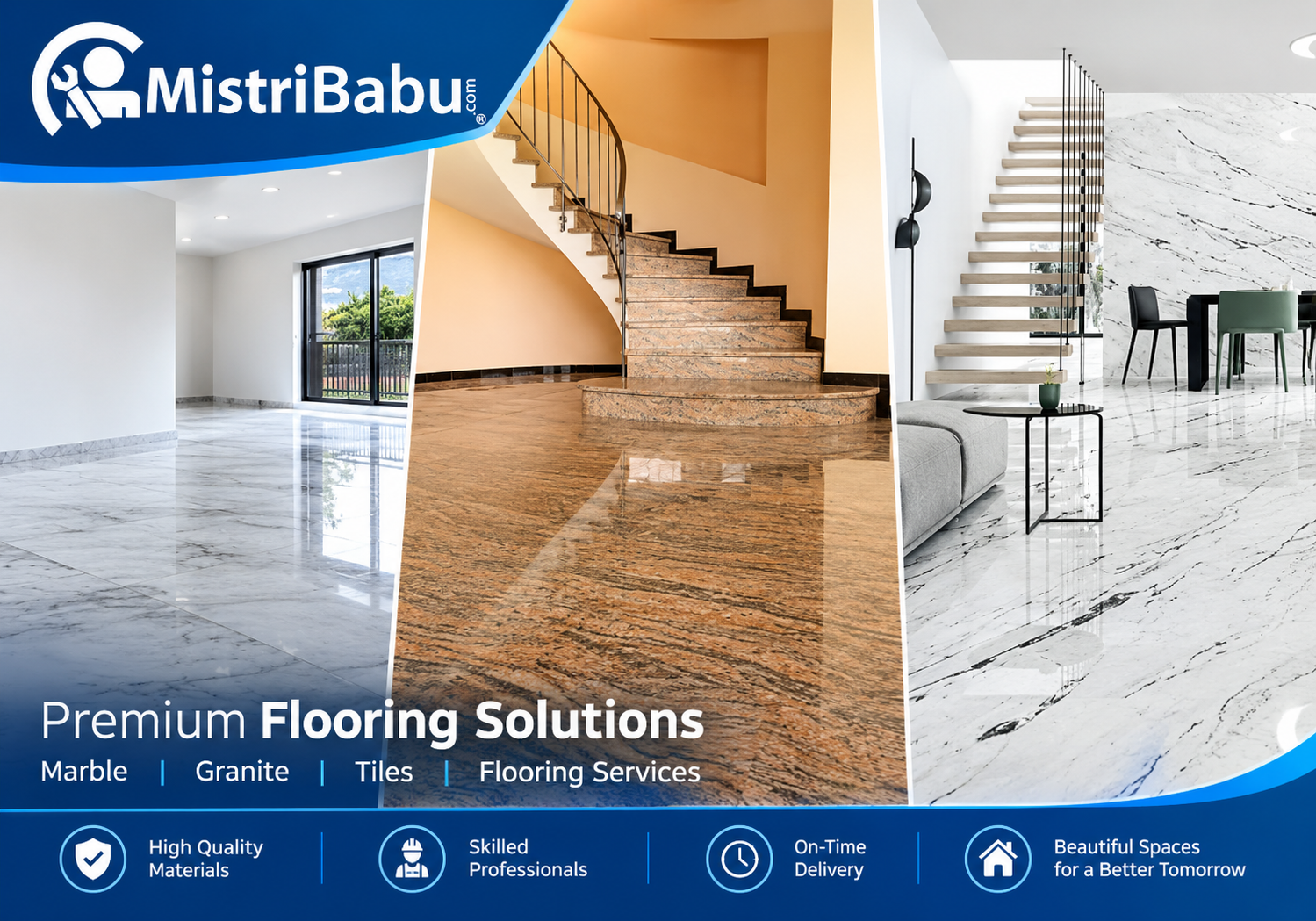
Choosing the right flooring material is an important decision when constructing, renovating or upgrading a home. Flooring affects the appearance, durability, maintenance, comfort and long-term cost of your property.
Three popular flooring materials in India are marble, tiles and granite. Marble is known for its natural elegance, tiles offer extensive designs and budget options, and granite is valued for its hardness and durability.
Whether you are building a home in Bhubaneswar, renovating an apartment in Delhi NCR, designing a villa in Bengaluru or upgrading a property in Mumbai, Pune, Kolkata, Hyderabad or Chennai, understanding the differences between these materials will help you make the right decision.
1. What Is Marble Flooring?
Marble is a natural stone formed when limestone undergoes heat and pressure over geological time. It is widely used in residential properties, luxury villas, hotels, apartments and commercial interiors.
Marble is available in white, cream, beige, green, grey, brown and other colours. Natural veins and variations make each slab distinctive.
Advantages of Marble Flooring
- Premium appearance: Creates an elegant and sophisticated interior.
- Natural patterns: Every slab has its own distinctive colour variations and veins.
- Cool surface: Can feel comfortable underfoot in warm weather.
- Long service life: Quality marble can last for decades with appropriate installation and maintenance.
- Polishing potential: Many marble surfaces can be professionally polished to restore their appearance.
- Versatile applications: Suitable for living rooms, bedrooms, entrance foyers, staircases and feature areas.
Disadvantages of Marble Flooring
- Requires more maintenance than many glazed tiles.
- Can stain when exposed to oil, coloured liquids and other substances.
- Is sensitive to acidic cleaners, including vinegar and certain toilet cleaners.
- Can scratch, etch or lose its polish over time.
- May require sealing depending on the stone and application.
- Installation, cutting, levelling, polishing and transportation can increase the overall cost.
Best Applications for Marble
Marble is particularly suitable for luxury living rooms, premium bedrooms, entrance foyers, villas and feature areas. For bathrooms and wet areas, choose a finish with suitable slip resistance rather than selecting highly polished marble solely for its appearance.
2. What Is Tile Flooring?
Tiles are manufactured from materials such as clay, ceramic mixtures, porcelain bodies and other engineered mineral compositions. They are available in many sizes, colours, patterns, textures and finishes.
Common varieties include ceramic tiles, porcelain tiles, vitrified tiles, full-body vitrified tiles, glazed vitrified tiles (GVT) and polished glazed vitrified tiles (PGVT).
Advantages of Tile Flooring
- Wide price range: Options are available for budget homes, apartments and premium residences.
- Design flexibility: Available in marble-look, wood-look, stone-look and concrete-look designs.
- Easy cleaning: Many glazed and porcelain tiles require relatively little routine maintenance.
- Water resistance: Suitable porcelain and glazed tiles can perform well in kitchens and bathrooms.
- Consistent appearance: Manufactured designs generally provide uniform colours and dimensions.
- Replacement flexibility: Individual damaged tiles can sometimes be replaced.
- Climate suitability: Suitable products are available for hot, humid, rainy and cooler regions.
Disadvantages of Tile Flooring
- Tiles may crack or chip if impacted or installed over an unsuitable substrate.
- Poor installation can cause hollow sounds, uneven surfaces and loose tiles.
- Grout joints can collect dirt, stains and mould.
- Matching discontinued designs can be difficult.
- Glossy tiles can become slippery when wet.
- Large-format tiles require suitable surface preparation and skilled installation.
Best Applications for Tiles
Tiles are suitable for living rooms, bedrooms, kitchens, bathrooms, balconies, utility areas, corridors, terraces and commercial spaces. For wet areas, prioritise slip resistance and a suitable installation system.
3. What Is Granite Flooring?
Granite is a natural igneous rock known for its hardness, strength and distinctive mineral patterns. It is widely used in residential flooring, staircases, kitchen countertops, entrance areas and commercial properties.
Common colours include black, grey, white, red, brown and multicoloured varieties.
Advantages of Granite Flooring
- High hardness: Generally offers good resistance to everyday wear and abrasion.
- Durability: Suitable for many high-traffic areas when correctly selected and installed.
- Natural appearance: Provides distinctive mineral patterns and colours.
- Long-term performance: Can remain serviceable for decades with appropriate maintenance.
- Polishing options: Many granite varieties can be professionally repolished.
- Multiple applications: Suitable for floors, staircases, thresholds and selected outdoor spaces.
Disadvantages of Granite Flooring
- Natural slabs may vary in colour, pattern and thickness.
- Heavy slabs require skilled handling and installation.
- Cutting and finishing can increase labour costs.
- Polished granite can be slippery when wet.
- Some varieties may require sealing.
- Repairs and replacements can be challenging if the original stone is unavailable.
- Dark surfaces may show dust and water marks more visibly.
Best Applications for Granite
Granite is well suited to entrance foyers, staircases, corridors, busy living areas and selected outdoor surfaces. For balconies, exterior steps and exposed areas, select a finish suitable for moisture, weather and foot traffic.
4. Marble vs. Tile vs. Granite: Complete Comparison
| Feature | Marble | Tiles | Granite |
|---|---|---|---|
| Material | Natural stone | Manufactured material | Natural stone |
| Appearance | Luxurious natural veins | Extensive design choices | Distinctive mineral patterns |
| Durability | Good with proper care | Good to excellent, depending on type | Excellent for many applications |
| Scratch resistance | Moderate; varies by stone | Varies by tile type | Generally high |
| Stain resistance | Requires care | Generally good for glazed surfaces | Generally good; varies by variety |
| Water resistance | Depends on stone and sealing | Porcelain generally performs very well | Generally good; varies by stone |
| Cleaning | Gentle, pH-neutral cleaners | Generally easy | Generally easy |
| Polishing | May require periodic polishing | Usually no stone polishing required | Can be professionally repolished |
| Design choices | Natural colour variations | Extensive colours, sizes and patterns | Natural colours and patterns |
| Initial budget | Medium to premium | Budget to premium | Medium to premium |
| Best applications | Premium living rooms and bedrooms | Whole-home flooring and wet areas | Staircases, entrances and high-traffic areas |
Actual performance depends on material grade, surface finish, installation quality, maintenance and the intended application. Porcelain tiles, for example, can have significantly different performance characteristics from ordinary ceramic tiles.
5. Marble vs. Tile vs. Granite: Price Comparison in India
Flooring costs vary according to material quality, size, brand, finish, transportation, wastage and installation requirements.
The following are indicative material-only planning ranges, not fixed quotations.
| Flooring material | Indicative material cost per sq. ft. |
|---|---|
| Ceramic tiles | ₹30–₹100 |
| Vitrified tiles | ₹40–₹200 |
| Premium porcelain tiles | ₹80–₹300+ |
| Indian marble | ₹100–₹400+ |
| Italian or imported marble | ₹300–₹1,500+ |
| Standard granite | ₹80–₹300 |
| Premium granite | ₹250–₹600+ |
These prices are indicative and may vary considerably by supplier and location. Installation labour, GST where applicable, wastage, mortar or adhesive, levelling, skirting, grouting, transport, polishing and sealing may be additional.
Factors Affecting Total Flooring Cost
- Floor preparation: Removing old flooring, repairing cracks and levelling the base.
- Material wastage: Extra material for cutting, patterns, corners and future replacement.
- Installation labour: Different materials require different installation skills.
- Adhesive or mortar: The correct bonding system is essential.
- Grouting and joint finishing: Joint width and grout type influence appearance and maintenance.
- Skirting and stair edges: These details can increase the total cost.
- Polishing and sealing: Natural stone may require additional finishing.
- Transportation and handling: Heavy slabs and difficult site access can increase expenses.
- Taxes and other applicable charges: Confirm these in the contractor's quotation.
Example: Flooring a 1,000 Sq. Ft. Home
Assume illustrative material costs of ₹80 per sq. ft. for tiles, ₹180 for marble and ₹150 for granite.
| Material | Area | Illustrative material cost |
|---|---|---|
| Tiles | 1,000 sq. ft. | ₹80,000 |
| Marble | 1,000 sq. ft. | ₹1,80,000 |
| Granite | 1,000 sq. ft. | ₹1,50,000 |
These are hypothetical examples, not market quotations. They exclude installation and other project expenses. Premium tiles can cost more than some natural stones, while imported marble can be considerably more expensive.
6. Which Flooring Is Best for Each Room?
Living Room and Drawing Room
Marble suits premium interiors, while large-format vitrified tiles offer a practical alternative with fewer visible joints. Granite is suitable when durability and natural stone aesthetics are priorities.
Bedroom
Choose marble for a natural premium appearance or matte vitrified tiles for straightforward maintenance. Light-coloured flooring can complement compact bedrooms and different furniture styles.
Kitchen
Granite is a popular countertop material. For the floor, select durable tiles with suitable slip resistance and easy-clean properties. Marble needs additional care around oil, turmeric and acidic food spills.
Bathroom and Toilet
Prefer appropriately rated matte or textured porcelain tiles. Ensure waterproofing beneath the finished floor, correct slope and reliable drainage. Consider slip risk before selecting a polished surface.
Staircase and Entrance
Granite is a strong option for durability and frequent use. Marble also works well in premium staircases. Select suitable edge details and a finish that helps reduce slipping.
Balcony, Terrace and Outdoor Areas
Choose exterior-grade tiles or suitable textured natural stone. Consider drainage, waterproofing, surface grip, thermal movement and weather exposure.
7. Which Material Is Best for India's Climate?
India experiences hot-dry, hot-humid, composite, temperate and cold climatic conditions. The right flooring depends on local weather, ventilation, moisture exposure and building construction.
| Climate or region | Example locations | Recommended approach |
|---|---|---|
| Hot and dry | Jaipur, Jodhpur, Bikaner, Jaisalmer, Ahmedabad | Consider light-coloured marble, granite or tiles |
| Hot and humid | Chennai, Kochi, Mangaluru, Visakhapatnam | Prefer moisture-suitable tiles or suitable natural stone |
| Coastal and monsoon-prone | Bhubaneswar, Puri, Cuttack, Mumbai, Panaji | Prioritise slip resistance, drainage and correct installation |
| Composite climate | Delhi, Gurugram, Noida, Lucknow, Bhopal | Tiles, marble and granite can all work |
| Warm and humid interior regions | Kolkata, Guwahati, Patna, Ranchi | Consider dampness, cleaning and subfloor condition |
| Cooler and mountainous areas | Shimla, Srinagar, Leh, Gangtok, Itanagar | Consider indoor comfort and weather-appropriate outdoor finishes |
Flooring Recommendations for Odisha
Odisha experiences hot weather, humidity and seasonal monsoon rainfall. Coastal areas can also experience salt-laden air and prolonged damp conditions.
For homes in Bhubaneswar, Cuttack, Puri, Khordha, Jajpur, Kendrapara, Jagatsinghpur, Bhadrak, Balasore, Ganjam and other parts of Odisha:
- Use suitable vitrified tiles for living rooms, bedrooms and frequently cleaned areas.
- Choose textured or anti-slip tiles for bathrooms, balconies and exterior walkways.
- Consider marble for elegant interiors when appropriate maintenance is possible.
- Consider granite for staircases, entrance areas and selected high-traffic surfaces.
- Ensure terrace and balcony waterproofing, drainage, substrate preparation and flooring installation are completed correctly.
These are general recommendations. Site inspection is important when rising dampness, seepage, uneven floors or existing cracks are present.
8. State-Wise Flooring Guide: All States and Union Territories of India
Marble, tiles and granite can be considered for residential projects across India. However, the right selection depends on local weather, material availability, transportation costs, building design and the intended application.
28 States of India
1. Andhra Pradesh: Visakhapatnam, Vijayawada, Guntur, Tirupati, Nellore, Kurnool, Rajamahendravaram, Kakinada, Anantapuramu, Kadapa, Eluru, Ongole and Srikakulam. Areas include Madhurawada, Gajuwaka, Benz Circle, Poranki and Mangalagiri. Vitrified tiles are a versatile choice for residential floors.
2. Arunachal Pradesh: Itanagar, Naharlagun, Pasighat, Tawang, Ziro, Aalo and Tezu. Areas include Papu Nallah, Nirjuli and Chimpu. Consider durable tiles or suitable stone, with attention to rainfall and transport availability.
3. Assam: Guwahati, Dibrugarh, Jorhat, Silchar, Tezpur, Tinsukia, Nagaon, Sivasagar, Dhubri and Bongaigaon. Areas include Dispur, Six Mile, Beltola, Jalukbari, Khanapara and Zoo Road. Prioritise moisture suitability and proper subfloor preparation.
4. Bihar: Patna, Gaya, Muzaffarpur, Bhagalpur, Darbhanga, Purnia, Begusarai, Ara, Chapra and Bihar Sharif. Areas include Kankarbagh, Boring Road, Danapur, Phulwari Sharif, Bailey Road and Rajendra Nagar. Vitrified tiles are practical for many residential applications.
5. Chhattisgarh: Raipur, Bilaspur, Durg, Bhilai, Korba, Jagdalpur, Raigarh, Ambikapur and Rajnandgaon. Areas include Shankar Nagar, Telibandha, Avanti Vihar, Supela and Nehru Nagar. Choose tiles or granite according to budget and traffic.
6. Goa: Panaji, Margao, Vasco da Gama, Mapusa, Ponda, Calangute, Porvorim and Bicholim. Areas include Dona Paula, Taleigao, Bambolim, Verna and Colva. Consider moisture, coastal exposure and slip resistance.
7. Gujarat: Ahmedabad, Surat, Vadodara, Rajkot, Gandhinagar, Bhavnagar, Jamnagar, Junagadh, Anand and Morbi. Areas include Satellite, Bopal, Thaltej, Gota, Vastrapur, Adajan, Vesu and Alkapuri. Marble, granite and vitrified tiles offer varied design and budget options.
8. Haryana: Gurugram, Faridabad, Panipat, Karnal, Hisar, Rohtak, Sonipat, Ambala, Panchkula and Yamunanagar. Areas include DLF Phases 1–5, Sohna Road, Golf Course Road, Sector 56, Sector 82, Sector 15 and Sector 21. Select flooring according to property type, budget and maintenance needs.
9. Himachal Pradesh: Shimla, Solan, Dharamshala, Mandi, Kullu, Manali, Una, Hamirpur, Bilaspur and Chamba. Areas include Sanjauli, New Shimla, Baddi, Kasauli and McLeod Ganj. Consider indoor comfort and weather-appropriate exterior flooring.
10. Jharkhand: Ranchi, Jamshedpur, Dhanbad, Bokaro, Deoghar, Hazaribagh, Giridih, Ramgarh, Medininagar and Chaibasa. Areas include Morabadi, Harmu, Lalpur, Doranda, Adityapur, Sakchi and Bistupur. Vitrified tiles suit many homes, while granite and marble serve specific applications.
11. Karnataka: Bengaluru, Mysuru, Mangaluru, Hubballi, Dharwad, Belagavi, Kalaburagi, Davanagere, Ballari and Shivamogga. Areas include Whitefield, Sarjapur Road, Electronic City, Yelahanka, Hebbal, Jayanagar, JP Nagar and HSR Layout. Vitrified tiles are versatile, while granite and marble offer alternative finishes.
12. Kerala: Thiruvananthapuram, Kochi, Kozhikode, Thrissur, Kollam, Kannur, Kottayam, Palakkad, Alappuzha and Malappuram. Areas include Kakkanad, Edappally, Vyttila, Aluva, Kazhakkoottam, Palarivattom and Kalamassery. Consider humidity, ventilation and moisture protection.
13. Madhya Pradesh: Bhopal, Indore, Jabalpur, Gwalior, Ujjain, Sagar, Rewa, Satna, Ratlam and Dewas. Areas include Arera Colony, Kolar Road, Vijay Nagar, Nipania, Rau and Civil Lines. Vitrified tiles, marble and granite are all potential choices.
14. Maharashtra: Mumbai, Pune, Thane, Navi Mumbai, Nashik, Nagpur, Kolhapur, Chhatrapati Sambhajinagar, Solapur and Amravati. Areas include Andheri, Borivali, Powai, Thane West, Kharghar, Vashi, Wakad, Hinjewadi, Baner and Kothrud. Consider apartment specifications, humidity and total installed cost.
15. Manipur: Imphal, Thoubal, Kakching, Churachandpur, Bishnupur and Senapati. Areas include Porompat, Singjamei and Lamphel. Choose durable flooring with suitable slip resistance and moisture protection.
16. Meghalaya: Shillong, Tura, Jowai, Nongpoh, Williamnagar, Baghmara and Sohra. Areas include Laitumkhrah, Mawlai, Nongthymmai, Polo and Upper Shillong. Prioritise traction, drainage and wet-weather suitability.
17. Mizoram: Aizawl, Lunglei, Champhai, Serchhip, Kolasib, Lawngtlai and Saitual. Areas include Chanmari, Dawrpui and Bawngkawn. Consider installation requirements and material transportation to hilly locations.
18. Nagaland: Kohima, Dimapur, Mokokchung, Wokha, Tuensang, Mon and Zunheboto. Areas include Chümoukedima, Purana Bazaar and Duncan Basti. Choose tiles or suitable stone with reliable installation and weather-appropriate finishes.
19. Odisha: Bhubaneswar, Cuttack, Puri, Khordha, Sambalpur, Rourkela, Berhampur, Balasore, Bhadrak, Jajpur, Kendrapara, Jagatsinghpur, Nayagarh, Kendujhar, Angul, Dhenkanal, Jharsuguda, Bargarh, Koraput, Rayagada, Ganjam, Gajapati, Kandhamal, Kalahandi, Nuapada, Subarnapur, Boudh, Deogarh and Mayurbhanj. Areas include Patia, Chandrasekharpur, Nayapalli, Khandagiri, Tamando, Old Town, Saheed Nagar, Rasulgarh, Jaydev Vihar, Cuttack CDA, Badambadi, Jagamara, Puri town and Paradeep. Consider vitrified tiles for practical flooring, marble for premium interiors and granite for selected high-traffic applications.
20. Punjab: Ludhiana, Amritsar, Jalandhar, Patiala, Bathinda, Mohali, Hoshiarpur, Pathankot and Moga. Areas include Model Town, Dugri, Zirakpur, Kharar, Aerocity Mohali and Urban Estate. Marble and vitrified tiles are common options for residential flooring.
21. Rajasthan: Jaipur, Jodhpur, Udaipur, Kota, Ajmer, Bikaner, Alwar, Bhilwara, Sikar, Bharatpur and Chittorgarh. Areas include Vaishali Nagar, Mansarovar, Jagatpura, Malviya Nagar, C-Scheme and Shastri Nagar. Consider marble, granite or light-coloured tiles based on design and maintenance preferences.
22. Sikkim: Gangtok, Namchi, Gyalshing, Mangan, Pakyong and Soreng. Areas include Deorali, Tadong and Ranipool. Choose suitable finishes for rainy, sloping and cooler locations.
23. Tamil Nadu: Chennai, Coimbatore, Madurai, Tiruchirappalli, Salem, Tiruppur, Erode, Vellore, Thanjavur, Tirunelveli and Hosur. Areas include Anna Nagar, Velachery, OMR, Tambaram, Porur, Adyar, Saravanampatti and Peelamedu. Consider vitrified tiles for practical maintenance and granite or marble for selected applications.
24. Telangana: Hyderabad, Warangal, Karimnagar, Nizamabad, Khammam, Ramagundam, Siddipet and Mahabubnagar. Areas include Gachibowli, Madhapur, Kondapur, Miyapur, Kukatpally, Banjara Hills, Jubilee Hills, Manikonda and Uppal. Select flooring based on design, budget and maintenance.
25. Tripura: Agartala, Udaipur, Dharmanagar, Kailashahar, Belonia and Ambassa. Areas include Banamalipur, Kunjaban and Pratapgarh. Consider moisture-suitable flooring with proper waterproofing and drainage.
26. Uttar Pradesh: Lucknow, Noida, Ghaziabad, Agra, Kanpur, Varanasi, Prayagraj, Meerut, Gorakhpur, Bareilly, Jhansi, Mathura, Aligarh, Moradabad and Ayodhya. Areas include Gomti Nagar, Indira Nagar, Aliganj, Sushant Golf City, Noida Sectors 50, 62 and 137, Greater Noida West, Vaishali, Indirapuram and Raj Nagar Extension. Vitrified tiles are a versatile option, while marble suits premium interiors.
27. Uttarakhand: Dehradun, Haridwar, Roorkee, Haldwani, Rudrapur, Kashipur, Rishikesh, Almora, Nainital and Pithoragarh. Areas include Rajpur Road, Sahastradhara Road, Clement Town, Raipur and Prem Nagar. Consider temperature, moisture and outdoor exposure.
28. West Bengal: Kolkata, Howrah, Durgapur, Asansol, Siliguri, Kharagpur, Bardhaman, Haldia, Malda and Berhampore. Areas include New Town, Salt Lake, Rajarhat, Tollygunge, Behala, Garia, Ballygunge, Dum Dum and Alipore. Vitrified tiles and suitable granite are practical choices for many homes, while marble offers premium aesthetics.
All 8 Union Territories
1. Andaman and Nicobar Islands: Port Blair (Sri Vijaya Puram), Diglipur, Mayabunder and Rangat. Consider moisture-suitable flooring and finishes appropriate for coastal exposure.
2. Chandigarh: Sector 17, Sector 22, Sector 35 and Manimajra. Vitrified tiles are practical, while marble suits premium homes.
3. Dadra and Nagar Haveli and Daman and Diu: Silvassa, Daman and Diu. Consider humidity, coastal exposure and suitable slip resistance.
4. Delhi: Dwarka, Rohini, Saket, Vasant Kunj, Janakpuri, Pitampura, Lajpat Nagar, Mayur Vihar and surrounding residential areas. Vitrified tiles suit versatile residential flooring, while marble is popular for premium interiors.
5. Jammu and Kashmir: Srinagar, Jammu, Anantnag, Baramulla and Udhampur. Consider winter comfort, moisture and outdoor conditions.
6. Ladakh: Leh, Kargil and surrounding settlements. Select flooring and installation systems suitable for cold conditions.
7. Lakshadweep: Kavaratti, Agatti, Andrott and Minicoy. Choose coastal-appropriate tiles and suitable installation materials.
8. Puducherry: Puducherry, Karaikal, Mahe and Yanam. Consider moisture suitability and slip resistance.
Location coverage note: These are representative cities, districts and residential areas, not an exhaustive list of every district, village, ward or neighbourhood in India. Verify local administrative boundaries and service availability before publishing location-specific pages.
9. Flooring Selection for Major Indian Cities
| City or market | Example residential areas | Flooring considerations |
|---|---|---|
| Delhi NCR | Dwarka, Vasant Kunj, Noida, Greater Noida, Gurugram, Faridabad | Budget, indoor comfort and maintenance |
| Mumbai and Navi Mumbai | Andheri, Powai, Thane, Vashi, Kharghar | Humidity and water ingress |
| Pune | Baner, Wakad, Hinjewadi, Kothrud, Hadapsar | Design, budget and installation quality |
| Bengaluru | Whitefield, Sarjapur Road, Electronic City, Hebbal | Easy cleaning and consistent appearance |
| Hyderabad | Gachibowli, Kondapur, Madhapur, Miyapur | Large-format tiles and maintenance |
| Chennai | OMR, Velachery, Tambaram, Anna Nagar | Humidity and wet-area performance |
| Kolkata | New Town, Salt Lake, Behala, Garia | Dampness and suitable finishes |
| Bhubaneswar | Patia, Chandrasekharpur, Khandagiri, Nayapalli | Monsoon preparation and slip resistance |
| Cuttack | CDA, Badambadi, College Square, Jagatpur | Water management and installation |
| Puri | Puri town, Baliapanda and Sea Beach Road area | Coastal exposure and slip resistance |
| Jaipur | Mansarovar, Jagatpura, Vaishali Nagar | Heat, dust and colour selection |
| Lucknow | Gomti Nagar, Indira Nagar, Aliganj | Maintenance and project cost |
| Ahmedabad | Bopal, Satellite, Gota, Vastrapur | Heat and budget |
| Kochi | Kakkanad, Edappally, Vyttila | Humidity and moisture |
| Guwahati | Beltola, Dispur, Six Mile, Khanapara | Rainfall and drainage |
10. Flooring Installation Process
Correct installation is essential for the durability and appearance of marble, tiles and granite.
Step 1: Measure the Area
Measure each room, identify door openings and mark columns, thresholds, drains and floor levels. Calculate the required material quantity and an appropriate wastage allowance.
Step 2: Inspect and Prepare the Base
Check the concrete or screed for cracks, loose material, unevenness and moisture. Repair defects and confirm that the substrate is suitable for the selected flooring system.
Step 3: Select the Correct Laying System
Natural stone and different tile types may require different mortar or adhesive systems. Follow the material manufacturer's instructions and relevant installation standards.
Step 4: Plan the Layout
Establish reference lines, joint spacing, pattern alignment and cutting positions. For marble and granite, inspect slabs for colour variations and arrange them for a balanced appearance.
Step 5: Install and Level the Flooring
Lay the material using the approved bonding method. Check level, alignment, lippage, joint width and coverage. Follow the specified curing requirements.
Step 6: Finish and Inspect
Complete grouting, skirting and appropriate stone finishing or sealing. Inspect for cracked pieces, uneven joints, hollow areas and stains before protecting the completed floor.
Important Technical Considerations
- Allow movement joints wherever required by the flooring system and building design.
- Do not cover structural movement joints with rigid flooring.
- Waterproof wet areas before installing the finished floor.
- Maintain the correct slope towards bathroom drains.
- Use appropriate expansion-joint details for exposed terraces and balconies.
- Follow the adhesive, grout, sealer and flooring manufacturer's technical instructions.
11. Marble, Tile and Granite Maintenance Guide
| Maintenance activity | Marble | Tiles | Granite |
|---|---|---|---|
| Daily cleaning | Sweep and damp mop | Sweep and mop | Sweep and mop |
| Cleaning product | pH-neutral stone cleaner | Suitable mild floor cleaner | Mild natural-stone cleaner |
| Spill management | Clean promptly | Clean promptly, including grout | Clean promptly |
| Acidic cleaners | Avoid | Check manufacturer's guidance | Avoid unsuitable acidic cleaners |
| Sealing | As required by stone and exposure | Usually unnecessary for glazed surfaces; grout may need care | Depends on porosity and application |
| Restoration | Professional honing or polishing | Replace damaged tiles or repair grout | Professional stone restoration where needed |
For all three materials, use furniture pads, avoid dragging heavy furniture and repair leaks promptly. Confirm that cleaning chemicals are compatible with the actual flooring material.
12. Common Flooring Mistakes to Avoid
- Choosing flooring only by appearance without considering its intended use.
- Buying materials without checking grade, finish, thickness and batch consistency.
- Selecting glossy tiles for wet areas without evaluating slip resistance.
- Installing flooring over damp, cracked or uneven substrates.
- Ignoring waterproofing in bathrooms, balconies and terraces.
- Using harsh chemicals on natural stone.
- Underestimating wastage, transport, cutting and finishing expenses.
- Failing to retain spare tiles or records of the original stone selection.
- Skipping required movement joints.
- Hiring installers without checking relevant experience and completed projects.
13. FAQs
1. Which is better for a home: marble, tiles or granite?
There is no single best material for every home. Vitrified tiles are a versatile choice for many residential floors, marble suits premium interiors, and granite is well suited to selected high-traffic areas and staircases.
2. Which flooring is the most durable?
Granite is generally very hard and wear-resistant. Quality porcelain or vitrified tiles can also provide excellent durability. Performance depends on the specific material, installation, loading and maintenance.
3. Which is the most affordable flooring material?
Standard ceramic tiles and many vitrified tiles are often economical choices. Compare the complete installed cost rather than the material price alone.
4. Is marble suitable for Indian weather?
Yes. Marble can work well in many Indian homes, particularly in living rooms and bedrooms. It needs appropriate cleaning and protection, and its suitability for wet areas depends on the stone and finish.
5. Are tiles better than marble for humid cities?
Glazed and porcelain tiles are often easier to maintain in humid environments. Proper waterproofing, ventilation, drainage and installation remain essential regardless of the material.
6. Is granite good for flooring?
Yes. Granite is a durable natural stone suitable for entrances, staircases and many high-traffic areas. Choose an appropriate finish because polished granite can be slippery when wet.
7. Which material is best for bathroom flooring?
Suitable matte or textured porcelain tiles are a practical choice for many bathrooms. Check wet-area slip resistance and ensure that waterproofing, floor slope and drainage are properly completed.
8. Which flooring is best for kitchens?
Durable, easy-to-clean tiles are a practical flooring choice for many kitchens. Granite is also widely used for countertops. Marble needs additional precautions against staining and acid etching.
9. Can marble and granite be used outdoors?
Yes, when the particular stone, finish and installation are suitable for outdoor exposure. Consider slip resistance, weathering, drainage and temperature changes.
10. Do marble and granite require sealing?
Some varieties benefit from sealing, while others require less frequent treatment. The correct approach depends on absorption characteristics, finish and use.
11. Which flooring is easiest to clean?
Many glazed and porcelain tiles are easy to clean with regular sweeping and mopping. Granite can also be straightforward to maintain. Marble generally requires more care to prevent staining and etching.
12. Which flooring is best for a rental property?
Budget-friendly, durable vitrified tiles are often a practical option for rental homes because of their broad design range and relatively simple maintenance.
13. Which material is best for a luxury villa?
Marble is popular for premium living rooms, entrance foyers and statement interiors. Large-format porcelain tiles and selected granite varieties can also create a high-end appearance.
14. How do I calculate flooring material quantity?
Multiply the measured length by the width to calculate the area. Add an appropriate wastage allowance based on tile size, layout, cutting requirements and installation method. Measure irregular rooms separately.
15. Can I use different flooring materials in the same house?
Yes. You can use marble in the living room, vitrified tiles in bedrooms, anti-slip tiles in bathrooms and granite on staircases. Plan junctions and floor heights carefully.
14. Final Verdict: Which Flooring Should You Choose?
Best all-rounder: Vitrified tiles
A strong option for homeowners seeking design variety, straightforward maintenance and choices across a wide range of budgets.
Best for natural luxury: Marble
Ideal for premium living spaces where distinctive natural patterns and an elegant finish are priorities.
Best for hardness and heavy use: Granite
A strong choice for staircases, entrance areas and many high-traffic applications when the stone and finish are appropriate.
The best flooring for your home balances appearance, cost, durability, cleaning requirements, slip resistance and local climate. Before purchasing, compare samples under your actual lighting, verify the complete installed quotation and check the installation team's experience.

MistriBabu
Admin