
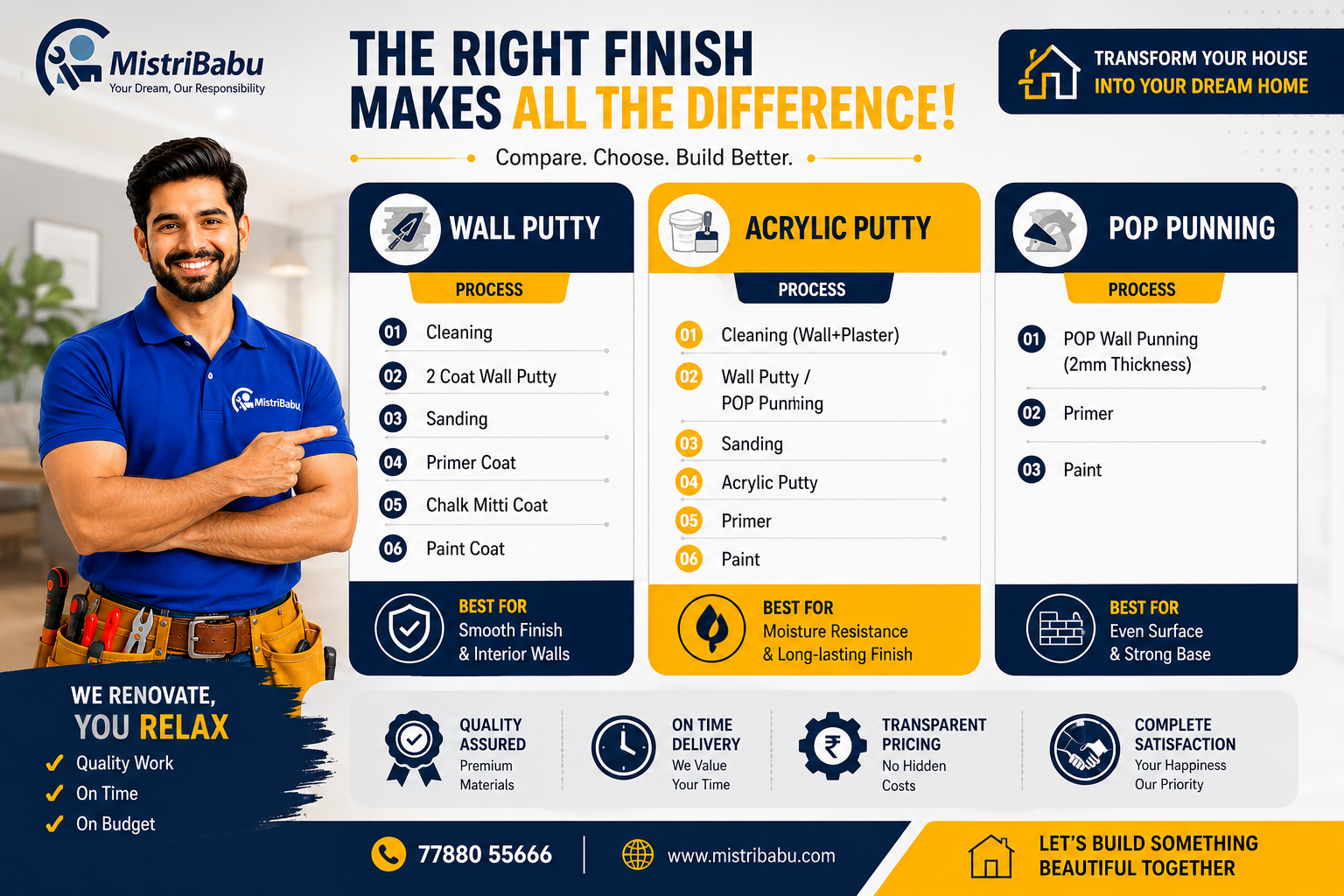
When building, renovating, or repainting a home, wall finishing is one of the most important stages before applying paint. A good wall finish improves the appearance of your home, creates a smooth painting surface, hides minor imperfections, and can help the paint perform better.
In Bhubaneswar, Odisha, homeowners commonly consider three options for wall finishing: cement-based wall putty, acrylic putty, and POP punning. Although all three can create a smooth surface, they are different in terms of material, application, durability, moisture resistance, finish, and cost.
If you are confused about wall putty vs acrylic putty vs POP punning, this guide explains the differences and provides indicative cost per sq. ft. in Bhubaneswar so you can choose the right solution for your home.
Quick Comparison: Wall Putty vs Acrylic Putty vs POP Punning
| Feature | Wall Putty | Acrylic Putty | POP Punning |
|---|---|---|---|
| Main material | White cement-based | Acrylic/polymer-based | Plaster of Paris/gypsum |
| Typical use | Interior & exterior | Mainly interior | Interior walls & decorative work |
| Finish | Smooth | Very smooth | Very smooth/fine |
| Moisture resistance | Good | Good for interiors | Lower |
| Exterior suitability | Yes, with suitable product | Generally not preferred | No |
| Durability | High | Good | Moderate |
| Application | Easy | Easy | Requires skilled application |
| Drying/setting | Moderate | Relatively quick | Quick setting |
| Repairability | Good | Good | Moderate |
| Cost | Economical | Higher | Usually higher |
| Best for | General homes | Premium interiors | Luxury/decorative interiors |
Important: Actual rates vary depending on wall condition, number of coats, material brand, thickness, labour, height, scaffolding, and project size.
What Is Wall Putty?
Wall putty is a finishing material applied over plastered walls before primer and paint. Cement-based wall putty is widely used because it can fill small pores, pinholes and minor surface imperfections while creating a smooth, uniform base.
For new construction, a typical finishing system is:
Plaster → Wall Putty → Sanding → Primer → Paint
Wall putty is particularly useful when the wall needs a durable and economical surface before painting.
Advantages of Wall Putty
- Creates a smooth painting surface
- Fills small pores and minor imperfections
- Improves the appearance of painted walls
- Good adhesion when applied correctly
- Suitable for many interior applications
- Exterior-grade cement-based products can be used outdoors
- Generally economical
- Suitable for large residential projects
Recent Indian cost references place basic wall-putty work, including material and application, broadly around ₹8–₹15 per sq. ft., depending on the specification and number of coats.
What Is Acrylic Putty?
Acrylic putty is a ready-to-use or polymer-based wall-finishing material designed primarily for smooth interior surfaces. Unlike traditional cement-based putty, acrylic putty generally comes in a ready-mixed form and can provide a very smooth finish.
It is commonly selected for premium interior walls, decorative areas and repainting projects where a fine surface is important.
Advantages of Acrylic Putty
- Very smooth finish
- Ready-to-use formulations are convenient
- Good adhesion on suitable surfaces
- Useful for interior walls
- Can be easier to apply in repair and repainting work
- Suitable for premium painting systems
- Can help create a refined finish under high-quality paint
Limitations of Acrylic Putty
Acrylic putty is generally more expensive than basic cement-based putty. It should also be selected according to the manufacturer's recommended application area.
For exterior walls or areas exposed to significant weather, a suitable exterior-grade cement-based system is generally preferable.
What Is POP Punning?
POP punning, or Plaster of Paris punning, is the application of a thin layer of POP over a plastered wall or ceiling to create a very smooth and refined surface.
POP is particularly popular for:
- Premium interior walls
- Decorative wall surfaces
- False ceilings
- Cornices
- Mouldings
- Decorative architectural details
POP can provide an exceptionally fine finish, but it is more sensitive to moisture than cement-based finishing materials. Therefore, it should generally be avoided on damp surfaces and exterior walls exposed to rain.
Wall Putty vs Acrylic Putty vs POP Punning: Detailed Comparison
1. Finish Quality
Wall Putty
Wall putty provides a smooth and uniform surface suitable for most residential painting requirements.
Acrylic Putty
Acrylic putty can provide an even finer and smoother finish, particularly for premium interior painting.
POP Punning
POP can provide a very fine finish and is often selected where a premium decorative appearance is required.
Winner for premium smoothness: POP/Acrylic Putty
2. Durability
Cement-based wall putty generally performs well when correctly applied over sound plaster and followed by proper primer and paint.
Acrylic putty can provide good interior performance, while POP is more vulnerable to moisture-related problems.
For normal residential walls where durability and practicality are priorities, cement-based wall putty is usually the safer choice.
Winner: Wall Putty
3. Moisture Resistance
Moisture is an important consideration in Bhubaneswar because coastal Odisha experiences humid conditions and seasonal heavy rainfall.
Cement-based exterior-grade putty is generally more appropriate for exterior applications. Acrylic products should be selected according to their manufacturer's specifications, while conventional POP is not recommended for damp or rain-exposed surfaces.
Winner for moisture-prone/exterior applications: Suitable Cement-Based Wall Putty
4. Cost
Cost depends on the number of coats, surface preparation, product quality and labour.
Indicative Indian market references show wall-putty application can range around ₹8–₹15 per sq. ft. for material plus application in many situations, while broader professional POP/putty work can cost considerably more depending on the scope.
Indicative Bhubaneswar Budget Range
| Work | Approx. Cost Per Sq. Ft.* |
|---|---|
| Cement-based wall putty | ₹10–₹18 |
| Acrylic putty | ₹15–₹25+ |
| POP punning | ₹18–₹55+ |
| Premium/specialized finish | ₹25–₹60+ |
*These are indicative planning ranges, not fixed quotations. The final Bhubaneswar rate depends on wall condition, number of coats, brand, thickness, sanding requirements, height and labour.
For comparison, some Indian market sources quote basic putty work around ₹18–₹35/sq. ft. and POP application around ₹25–₹45/sq. ft. when broader preparation and finishing work are included.
5. Application Time
POP sets relatively quickly, which can make it convenient for certain interior finishing applications.
Cement-based putty generally requires proper drying between coats and sanding before the next stage.
Acrylic putty can be convenient because many products are ready to use.
Best depends on the project: POP for quick-setting decorative work; acrylic for convenient premium interior finishing; cement putty for standard residential wall preparation.
6. Interior vs Exterior Use
| Application | Wall Putty | Acrylic Putty | POP Punning |
|---|---|---|---|
| Living room | Excellent | Excellent | Excellent |
| Bedroom | Excellent | Excellent | Excellent |
| Kitchen | Good with suitable product | Good with suitable product | Not preferred in damp conditions |
| Bathroom | Use moisture-appropriate system | Product-dependent | Not recommended for damp areas |
| Exterior wall | Excellent with exterior-grade product | Generally not preferred | Not recommended |
| Decorative wall | Good | Excellent | Excellent |
| False ceiling | Limited | Not typical | Excellent |
Which Is Best for New House Construction in Bhubaneswar?
For most new residential construction projects in Bhubaneswar, cement-based wall putty is the most practical option.
Why?
- It is economical.
- It provides a good base for primer and paint.
- It works well with properly cured plaster.
- Suitable exterior-grade products can be used outdoors.
- It is practical for large wall areas.
- It offers a good balance between cost and durability.
For premium interiors, you can consider acrylic putty or POP where the design and finish justify the additional cost.
Which Is Best for Premium Interior Walls?
If your priority is an extremely smooth, refined interior finish, acrylic putty or POP punning can be considered.
Choose Acrylic Putty When:
- You want a premium interior finish
- You prefer ready-to-use material
- You are working on interior walls
- The surface is already reasonably smooth
- You want a refined base for premium paint
Choose POP Punning When:
- You want a very fine decorative finish
- You are creating designer interiors
- You need mouldings or decorative elements
- The area is dry and protected from moisture
- You have skilled POP workers
Which Is Better for Exterior Walls?
For exterior walls, suitable cement-based exterior wall putty is generally the preferred option.
Exterior walls in Bhubaneswar are exposed to:
- Heavy monsoon rain
- Humidity
- Sunlight
- Dust
- Temperature variation
- Moisture penetration
POP should generally not be used as an exterior wall finishing material because it is not designed for continuous exposure to moisture.
Wall Putty vs Acrylic Putty vs POP: Pros and Cons
Wall Putty
Pros
- Economical
- Durable
- Good for general wall finishing
- Suitable for large areas
- Exterior-grade options available
- Good base for painting
Cons
- Requires proper mixing/application for powder products
- Requires sanding
- May not provide the ultra-fine finish of some premium systems
- Cannot correct major wall undulations
Acrylic Putty
Pros
- Smooth finish
- Convenient ready-to-use options
- Excellent for interior finishing
- Good for premium painting
- Useful for repairs and repainting
Cons
- Higher cost
- Mainly suited to interiors depending on product
- Not a substitute for correcting major structural or plaster defects
POP Punning
Pros
- Very smooth finish
- Excellent for decorative interiors
- Useful for mouldings and designer work
- Quick-setting material
- Suitable for false-ceiling-related finishing
Cons
- Poor choice for damp areas
- Not suitable for exterior exposure
- Requires skilled workmanship
- Can develop cracks or damage when moisture enters
- Generally less practical for moisture-prone areas
How Much Does Wall Putty Cost for a 1,000 Sq. Ft. Area?
Suppose your wall surface area is 1,000 sq. ft. and the indicative rate is ₹10–₹18 per sq. ft.
Cement-Based Wall Putty
1,000 × ₹10 = ₹10,000
to
1,000 × ₹18 = ₹18,000
So, an indicative budget would be around:
₹10,000–₹18,000
For acrylic putty at an indicative ₹15–₹25 per sq. ft.:
₹15,000–₹25,000
For POP punning at an indicative ₹18–₹30 per sq. ft.:
₹18,000–₹55,000
These figures are for preliminary budgeting only. Actual quotations should be prepared after checking the wall condition and exact scope of work.
How to Calculate Wall Finishing Cost
Use this simple formula:
Total Cost = Wall Area × Rate Per Sq. Ft.
For example:
Wall Area = 2,000 sq. ft.
Rate = ₹15/sq. ft.
Estimated Cost = 2,000 × ₹15 = ₹30,000
Remember that your floor area is not the same as your wall area. A 1,000 sq. ft. house can have considerably more than 1,000 sq. ft. of paintable wall and ceiling surface.
Proper Wall Finishing Process
A professional wall-finishing system should generally follow these steps:
Step 1: Inspect the Wall
Check for:
- Cracks
- Dampness
- Loose plaster
- Uneven surfaces
- Salt deposits
- Leakage
- Holes and joints
Step 2: Repair the Surface
Major cracks, leakage and damaged plaster should be repaired before applying putty.
Step 3: Allow Plaster to Cure
Fresh plaster should be properly cured and sufficiently dry before finishing work begins.
Step 4: Apply Putty or POP
Apply the selected material according to the manufacturer's recommended thickness and procedure.
Step 5: Sanding
After sufficient drying, sand the surface to remove ridges and imperfections.
Step 6: Apply Primer
Primer helps seal the surface and provides a suitable base for paint.
Step 7: Apply Paint
Finally, apply the selected interior or exterior paint system.
Common Mistakes to Avoid
1. Applying Putty on Damp Walls
Putty should not be used to hide an active leakage or dampness problem.
Fix the moisture source first.
2. Using POP in Moisture-Prone Areas
Bathrooms, damp walls and exterior surfaces require a moisture-appropriate finishing system.
3. Applying Excessively Thick Putty
Putty is intended for surface finishing, not for correcting major wall unevenness.
4. Skipping Sanding
Poor sanding can result in visible waves, ridges and uneven paint reflection.
5. Skipping Primer
Putty and primer perform different functions. Putty smooths the surface; primer prepares and seals the surface for painting.
6. Choosing Only on Price
The cheapest material is not always the most economical solution. Consider durability, application quality, surface condition and maintenance.
How to Choose the Right Wall Finish in Bhubaneswar
Consider these five factors before deciding:
1. Location of the Wall
Exterior walls need a different system from protected interior walls.
2. Moisture Exposure
Areas affected by humidity or leakage require appropriate moisture-resistant solutions.
3. Desired Finish
For a standard smooth finish, wall putty is generally sufficient. For premium interiors, acrylic or POP may be considered.
4. Budget
Cement-based wall putty is generally the most economical option.
5. Workmanship
Even the best material can produce a poor result if the surface preparation and application are incorrect.
Our Recommendation
For most homes in Bhubaneswar, Odisha, the best overall approach is:
For exterior walls:
Exterior-grade cement-based wall putty + primer + exterior paint
For standard interior walls:
Cement-based wall putty + primer + interior paint
For premium interior walls:
Acrylic putty + primer + premium paint
For decorative/premium POP work:
POP punning + suitable primer + interior paint
There is no single material that is best for every wall. The right choice depends on location, moisture exposure, surface condition, desired finish and budget.
Why Professional Application Matters
Wall finishing may look simple, but surface preparation has a major impact on the final appearance.
A professional team should check the wall before starting and determine:
- Required number of coats
- Existing plaster condition
- Moisture problems
- Cracks and repairs
- Suitable putty type
- Required sanding
- Primer compatibility
- Paint system
- Total wall area
In Bhubaneswar, homeowners can compare local contractors and finishing specialists before selecting a service provider. For example, MistriBabu provides construction and renovation services in the Bhubaneswar area.
Frequently Asked Questions
1. Which is better: wall putty or acrylic putty?
For standard residential work, cement-based wall putty is generally more economical and durable. Acrylic putty can be a better choice when a premium interior finish is the priority.
2. Is POP better than wall putty?
POP can provide a very fine finish, but wall putty is generally more practical for regular residential walls because of its durability, cost and wider application range.
3. Can POP punning be used on exterior walls?
Generally, no. Conventional POP is not recommended for exterior walls exposed to rain and moisture.
4. Which putty is best for Bhubaneswar weather?
For exterior walls, choose a good-quality exterior-grade cement-based wall putty suitable for the manufacturer's specified conditions.
5. Can acrylic putty be used outside?
This depends on the specific product. Many acrylic wall putties are intended primarily for interior applications, so always check the manufacturer's technical specifications before exterior use.
6. How much does wall putty cost per sq. ft. in Bhubaneswar?
A reasonable preliminary budget for cement-based wall putty work can be around ₹10–₹18 per sq. ft., while acrylic putty and POP can cost more depending on material, coats, surface preparation and labour.
7. Is wall putty waterproof?
Wall putty should not be considered a waterproofing system. It may offer some water resistance depending on the formulation, but active leakage and dampness must be treated separately.
8. How many coats of wall putty are required?
Usually one or two coats may be used depending on the wall condition and product specification. The exact number should be determined after inspecting the surface.
9. Can wall putty hide cracks?
Wall putty can fill minor surface imperfections, but structural or significant cracks require proper crack repair before putty application.
10. Should primer be applied after putty?
Yes. A typical painting system is putty → sanding → primer → paint, subject to the product manufacturer's recommendations.
Final Verdict: Which One Should You Choose?
If you are looking for the best balance of cost, durability and practical performance, choose cement-based wall putty.
If your priority is a premium interior finish, consider acrylic putty.
If your priority is very smooth decorative interior work, particularly where POP detailing is involved, POP punning can be appropriate.
Simple decision guide:
Best overall: Cement-based Wall Putty
Best premium interior finish: Acrylic Putty
Best decorative/POP finish: POP Punning
Best for exterior walls: Exterior-grade Cement-Based Putty
Best for moisture-prone areas: Appropriate moisture-resistant cement-based system
Best budget option: Cement-based Wall Putty
The most important factor is not simply the material—it is correct surface preparation, proper application, adequate drying, sanding, primer and quality paint.
If you are planning wall finishing, painting or home renovation in Bhubaneswar, Odisha, get the wall condition inspected before finalizing the material and rate.

MistriBabu
Admin