
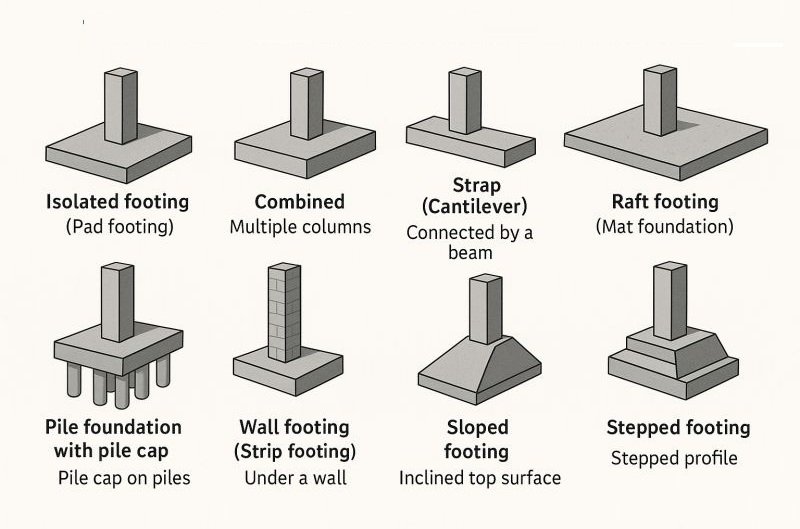
Building a house or commercial structure in Odisha requires proper foundation planning due to varied soil conditions, coastal humidity, flood-prone areas, and cyclone impact. Choosing the right foundation type ensures long-term safety, durability, and cost control.
In this detailed guide, we will explain the difference between Footing Foundation and Pile Foundation in Odisha, including advantages, disadvantages, cost factors, and district-wise suitability.
Understanding Foundation in Construction
A foundation is the lowest structural element of a building that transfers the load safely to the soil. In Odisha, soil types vary from coastal alluvial soil to laterite and black cotton soil, so selecting the correct foundation is critical.
The two most common foundation types used in residential and commercial construction are:
-
Footing Foundation (Shallow Foundation)
-
Pile Foundation (Deep Foundation)
1️⃣ Footing Foundation in Odisha
A footing foundation is a shallow foundation where loads are transferred directly to soil near the ground surface.
Types of Footings:
-
Isolated footing
-
Combined footing
-
Strip footing
-
Raft/Mat foundation
Where Footing Foundation is Suitable in Odisha
Footings are ideal where soil has good bearing capacity and groundwater level is not very high.
✔ Suitable districts in Odisha:
-
Bhubaneswar
-
Cuttack
-
Sambalpur
-
Jharsuguda
-
Balangir
-
Bargarh
-
Kalahandi
-
Nuapada
-
Sonepur
-
Angul
Advantages of Footing Foundation
✔ Lower construction cost
✔ Faster construction time
✔ Simple design and execution
✔ Ideal for G+1 or G+2 residential buildings
✔ Easy inspection and repair
Disadvantages of Footing Foundation
❌ Not suitable for weak or waterlogged soil
❌ Risk of differential settlement
❌ Not ideal for heavy multi-storey buildings
2️⃣ Pile Foundation in Odisha
Pile foundation is a deep foundation system where long reinforced concrete piles are driven or bored deep into the ground to reach strong strata.
Types of Pile Foundations:
-
End-bearing piles
-
Friction piles
-
Under-reamed piles
Where Pile Foundation is Required in Odisha
Pile foundations are recommended in areas with:
-
High groundwater table
-
Soft clay soil
-
Coastal sandy soil
-
Heavy load structures
✔ Commonly used in districts:
-
Puri
-
Kendrapara
-
Jagatsinghpur
-
Bhadrak
-
Balasore
-
Ganjam
-
Jajpur
-
Khordha
Advantages of Pile Foundation
✔ Suitable for weak soil conditions
✔ High load-bearing capacity
✔ Reduces settlement issues
✔ Ideal for apartments, commercial buildings & industrial structures
✔ Better performance in cyclone and flood-prone areas
Disadvantages of Pile Foundation
❌ Higher construction cost
❌ Requires heavy machinery
❌ Technical expertise required
❌ Longer execution time
Footing vs Pile Foundation – Detailed Comparison
| Factors | Footing Foundation | Pile Foundation |
|---|---|---|
| Depth | Shallow (Up to 3m) | Deep (5m–25m or more) |
| Cost | Economical | Expensive |
| Soil Requirement | Strong soil | Weak soil |
| Suitable Building | G+1, G+2 homes | Multi-storey buildings |
| Construction Speed | Faster | Slower |
| Equipment | Basic | Specialized machinery |
Soil Conditions in All Odisha Districts
Odisha has 30 districts, and soil conditions vary significantly:
-
Coastal districts: Sandy & soft soil
-
Western Odisha: Hard soil & laterite
-
Southern Odisha: Mixed red soil
-
Flood-prone belt: Soft alluvial soil
Major Districts in Odisha:
-
Bhubaneswar
-
Cuttack
-
Puri
-
Balasore
-
Bhadrak
-
Jagatsinghpur
-
Kendrapara
-
Jajpur
-
Ganjam
-
Gajapati
-
Rayagada
-
Koraput
-
Malkangiri
-
Nabarangpur
-
Kalahandi
-
Nuapada
-
Balangir
-
Sonepur
-
Bargarh
-
Sambalpur
-
Jharsuguda
-
Deogarh
-
Angul
-
Dhenkanal
-
Kandhamal
-
Mayurbhanj
-
Keonjhar
-
Nayagarh
-
Khordha
Approximate Cost Comparison in Odisha (2026)
Footing Foundation Cost:
₹650 – ₹950 per sq.ft (depending on soil & RCC design)
Pile Foundation Cost:
₹1050 – ₹1500 per running meter per pile
Total project cost depends on number & depth of piles.
Which Foundation is Best for Your Building in Odisha?
✔ Choose Footing Foundation if:
-
Soil bearing capacity is good
-
Building is G+1 or G+2
-
Budget is limited
-
Groundwater level is low
✔ Choose Pile Foundation if:
-
Coastal or flood-prone area
-
Heavy building load
-
Weak soil
-
Multi-storey apartment or commercial structure
Important Recommendation
Before finalizing foundation type in Odisha:
✅ Conduct Soil Test (SBC Test)
✅ Structural Engineer Consultation
✅ Consider Flood & Cyclone Zone
✅ Follow IS Codes for Foundation Design
1️⃣ Which foundation is best for house construction in Odisha?
The best foundation depends on soil condition and building load. In cities like Bhubaneswar and Sambalpur where soil bearing capacity is generally good, footing foundation is commonly used for G+1 or G+2 houses.
In coastal areas like Puri and Kendrapara, pile foundation is often recommended due to soft soil and high groundwater level.
2️⃣ What is the cost difference between footing and pile foundation in Odisha?
Footing foundation is more economical and generally costs less compared to pile foundation.
Pile foundation involves deeper excavation, reinforcement, and machinery, which increases overall cost. Final cost depends on soil test results, building design, and district location.
3️⃣ Is pile foundation necessary in coastal Odisha?
Yes, in many coastal districts like Jagatsinghpur and Balasore, soil is sandy and water table is high. In such cases, pile foundation provides better stability and reduces settlement risks.
4️⃣ Can I build a G+2 house with footing foundation in Odisha?
Yes, if the soil bearing capacity is adequate and approved by a structural engineer. In districts like Cuttack and Angul, many residential G+2 houses are constructed using isolated or combined footing foundations.
5️⃣ How important is soil testing before choosing foundation type?
Soil testing (SBC test) is extremely important. It determines the load-bearing capacity of the soil and helps engineers decide whether footing or pile foundation is required. Skipping soil testing can lead to structural cracks and settlement problems.
6️⃣ Which foundation is safer during cyclone and flood conditions in Odisha?
Pile foundation generally performs better in flood-prone and cyclone-affected coastal districts because it transfers load to deeper, stronger soil layers. However, proper structural design is equally important for long-term safety.
7️⃣ How deep should footing foundation be in Odisha?
Footing depth depends on soil type, groundwater level, and building load. Typically, residential footing depth ranges between 3 to 5 feet, but final depth should always be decided after soil investigation.
8️⃣ Is pile foundation only used for apartments and commercial buildings?
No, pile foundation can also be used for individual houses if soil is weak or plot is located in low-lying or waterlogged areas such as parts of Jajpur or Bhadrak.
Conclusion
Both footing and pile foundations are widely used across Odisha. The right choice depends on soil condition, load requirement, budget, and building type.
In western districts like Sambalpur and Balangir, footing foundations are commonly used due to better soil strength.
In coastal districts like Puri and Kendrapara, pile foundations are often preferred for stability against soft soil and waterlogging.
If you are planning new building construction anywhere in Odisha, always consult a qualified structural engineer before starting foundation work.

MistriBabu
Admin