
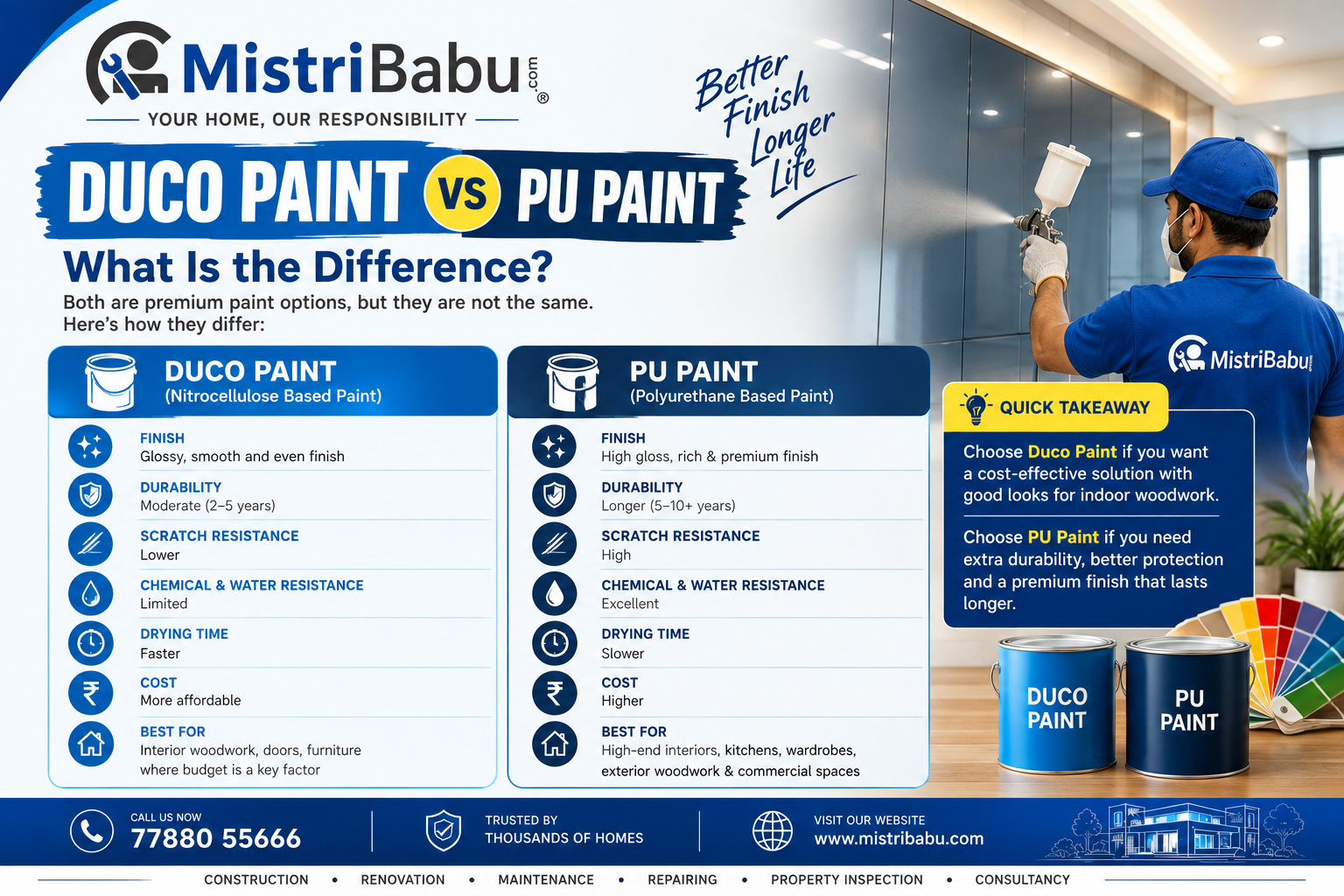
When choosing a premium finish for wooden furniture, wardrobes, kitchen cabinets, doors, wall panels and interior woodwork, two names commonly come up: Duco Paint and PU Paint.
Both can provide a smooth, attractive and modern finish, but they are different coating systems with different characteristics, durability, application methods and costs.
If you are planning home renovation, furniture renovation, modular kitchen finishing, wardrobe painting or wooden door painting, understanding the difference between Duco and PU paint can help you choose the right finish for your project.
Duco Paint vs PU Paint – Quick Comparison
| Feature | Duco Paint | PU Paint |
|---|---|---|
| Full form/type | Duco / NC lacquer | Polyurethane |
| Finish | Smooth, glossy or matte | Premium smooth, matte, satin or high gloss |
| Durability | Good | Excellent |
| Scratch resistance | Moderate to good | High |
| Moisture resistance | Good | Excellent |
| Chemical resistance | Moderate | High |
| Colour finish | Excellent | Excellent |
| Premium appearance | Very good | Excellent |
| Application | Usually spray application | Professional spray application preferred |
| Drying | Relatively fast | Requires curing time |
| Maintenance | Moderate | Easier for high-use surfaces |
| Cost | Generally lower | Generally higher |
| Best suited for | Budget to mid-range furniture | Premium and high-use furniture |
| Kitchen cabinets | Suitable | Highly suitable |
| Wardrobes | Suitable | Highly suitable |
| Wooden doors | Suitable | Excellent |
| High-use furniture | Good | Better |
| Outdoor use | Product dependent | Product dependent; exterior-grade system required |
Important: Actual performance depends on the specific coating system, substrate, preparation, application technique and manufacturer's specifications. Duco and PU should not be treated as interchangeable products.
What Is Duco Paint?
Duco is commonly used to describe a nitrocellulose lacquer/NC lacquer type finish used on furniture, woodwork and other surfaces. It is known for its smooth appearance, attractive colour and relatively fast drying.
Duco is commonly selected when the objective is to create a clean, uniform coloured finish without the higher cost of a premium PU system.
It can be used on properly prepared:
- MDF
- Plywood
- Wooden furniture
- Cabinets
- Wardrobes
- Doors
- Decorative panels
- Selected metal surfaces
Duco is particularly popular for modern furniture where a solid colour is required.
What Is PU Paint?
PU stands for Polyurethane.
PU coatings form a hard protective film and are widely used where durability, moisture resistance, scratch resistance and a premium appearance are important.
PU finishes can be available in different appearances, including:
- High gloss
- Gloss
- Satin
- Semi-matte
- Matte
- Clear/natural wood finish
- Pigmented/solid colour finish
PU is especially popular for premium furniture, wardrobes, kitchen cabinets, doors and high-use wooden surfaces. Polyurethane coatings are known for their durability, weather resistance, smooth finish and chemical resistance.
Duco Paint vs PU Paint: Main Differences
1. Durability
One of the biggest differences is durability.
Duco can provide a good decorative finish, but PU generally offers a tougher protective coating and is better suited to furniture exposed to frequent handling, moisture and everyday wear.
For premium long-term furniture finishing, PU is generally the preferred option.
2. Scratch Resistance
Furniture such as wardrobes, kitchen shutters, dining tables and frequently used cabinets can experience regular scratches.
PU generally provides better resistance to scratches and daily wear than a conventional Duco finish.
3. Moisture Resistance
Moisture is an important consideration in Indian homes, particularly in:
- Kitchens
- Utility areas
- Bathrooms
- Coastal regions
- Humid climates
A suitable PU coating can provide strong moisture resistance, although the coating does not make poorly constructed or moisture-damaged wood completely waterproof.
4. Finish and Appearance
Both Duco and PU can produce attractive finishes.
Duco is popular for a clean, uniform coloured appearance.
PU can provide a more premium, deeper and durable finish, particularly when professionally applied.
PU coatings are available in decorative and high-gloss finishes as well as other sheen levels.
5. Cost
Duco is generally selected where the customer wants a smooth painted finish at a comparatively lower cost.
PU normally costs more because of:
- Higher-grade coating systems
- Additional preparation
- Multiple application stages
- Hardener/component mixing where applicable
- Sanding between coats
- Professional spray application
- Controlled finishing requirements
- Higher labour skill
Therefore, PU is usually considered a premium furniture finish.
6. Application Skill
A high-quality finish depends heavily on surface preparation and application.
Typical professional finishing may involve:
- Surface inspection
- Sanding
- Cleaning
- Dent filling
- Primer/sealer
- Intermediate sanding
- Base coat
- Colour coat where applicable
- PU/top coat
- Final sanding/polishing and inspection
For example, Asian Paints recommends sanding wooden surfaces through progressively finer grades as part of preparation for its PU wood-finish system.
Is PU Better Than Duco?
For premium furniture and long-term durability, PU is generally the better choice.
For customers looking for a good-looking, smooth coloured finish at a lower budget, Duco can be a practical option.
Choose Duco when:
- Budget is important
- You want a smooth coloured finish
- The furniture has moderate usage
- You want comparatively faster finishing
- You are renovating decorative furniture
- You want a modern solid-colour appearance
Choose PU when:
- You want a premium finish
- Furniture receives heavy daily use
- Scratch resistance is important
- Moisture resistance is important
- You are finishing kitchen cabinets
- You are finishing premium wardrobes
- You want a long-lasting coating
- You want a high-gloss, satin or premium matte finish
Duco Paint for Furniture
Duco can be used for many interior furniture applications.
Common applications include:
- Wardrobes
- TV units
- Study tables
- Side tables
- Cabinets
- Wooden partitions
- MDF furniture
- Plywood furniture
- Decorative wall panels
- Interior doors
It is particularly suitable where the design calls for a uniform colour rather than a natural wood-grain appearance.
PU Paint for Furniture
PU is widely selected for premium furniture because it combines appearance with a strong protective coating.
Common applications include:
- Modular kitchens
- Kitchen shutters
- Wardrobes
- Wooden doors
- Dining tables
- Premium cabinets
- TV units
- Wall panelling
- Bedroom furniture
- Office furniture
- Premium interior woodwork
PU wood finishes are available in different visual styles, including clear, matte and high-gloss systems.
Duco vs PU for Modular Kitchen
For modular kitchens, PU is generally a stronger choice when the budget permits.
Kitchen cabinets are exposed to:
- Moisture
- Steam
- Oil
- Food stains
- Frequent cleaning
- Repeated opening and closing
- Scratches and impact
A suitable PU system can provide better resistance to these conditions.
However, the final result depends not only on the paint but also on the quality of MDF/plywood, edge treatment, primer, preparation and application.
Duco vs PU for Wardrobes
Both can be used for wardrobes.
Duco wardrobe
Best when:
- You want a coloured finish
- Budget is controlled
- Usage is moderate
- You want a simple modern appearance
PU wardrobe
Best when:
- You want a premium appearance
- Durability is important
- You want better scratch resistance
- You prefer matte, satin or high-gloss finishes
Duco vs PU for Wooden Doors
For interior doors, both options can work.
For premium doors, PU is often preferred because of its strong protective properties.
For exterior doors, however, do not automatically select an interior PU system. The coating must be specifically suitable for exterior exposure, UV radiation, moisture and the particular substrate.
Duco vs PU for MDF
MDF can be finished with both systems when properly prepared.
For MDF furniture, professional preparation is especially important because exposed edges and joints can absorb coating differently from flat surfaces.
A professional finishing process should address:
- Edge preparation
- Joint filling
- Sanding
- Primer/sealer
- Surface levelling
- Spray application
- Intermediate sanding
- Final coat
Duco vs PU: Which Has Better Gloss?
Both can achieve attractive gloss levels.
However, a professionally applied PU system can provide an exceptionally smooth and premium appearance.
High-gloss PU is particularly popular for:
- Luxury wardrobes
- Modular kitchens
- Designer cabinets
- TV units
- Premium furniture
- Decorative wall panels
Duco vs PU: Which Is More Durable?
PU generally wins for durability.
Polyurethane creates a tough protective layer that helps protect furniture against scratches, stains, moisture and regular wear.
That does not mean every PU product will automatically outperform every Duco product. Product quality, substrate preparation and workmanship have a major impact on the finished result.
Does PU Paint Make Wood Waterproof?
PU can provide strong resistance against water and moisture, but it should not be considered a substitute for waterproofing or proper construction.
If wood is continuously exposed to:
- Water leakage
- Rising damp
- Seepage
- Standing water
- Poor ventilation
the underlying problem should be corrected first.
A coating can protect the surface, but it cannot correct structural moisture problems.
Duco Paint vs PU Paint Cost in India
The final price depends on:
- Surface area
- Existing finish
- Furniture condition
- Type of substrate
- Number of coats
- Primer/sealer
- Paint brand
- Colour
- Gloss level
- Spray booth/workshop conditions
- On-site or factory finishing
- Labour
- Transportation
- Repair requirements
As a result, there is no single fixed price applicable to every project.
A proper estimate should be prepared after inspecting the furniture or receiving accurate measurements and specifications.
What Increases PU Painting Cost?
PU finishing can cost more because it may require:
- More preparation
- Better-quality materials
- Multiple coats
- Fine sanding
- Professional spray equipment
- Skilled applicators
- Controlled drying/curing
- More finishing time
For this reason, customers should compare quotations based on the complete system, not simply the price per square foot.
How to Get a Good Duco or PU Finish
The quality of the finish depends heavily on preparation.
Step 1: Surface Inspection
The existing furniture should be inspected for:
- Cracks
- Dents
- Peeling paint
- Moisture damage
- Open joints
- Uneven surfaces
- Loose veneer
- Damaged edges
Step 2: Sanding
The surface should be properly sanded to remove loose material and create an appropriate surface for the coating.
Step 3: Repair
Dents, holes, cracks and joints should be appropriately repaired.
Step 4: Primer or Sealer
The correct primer/sealer should be selected for the substrate and coating system.
Step 5: Intermediate Sanding
Sanding between coats helps create a smooth and uniform surface.
Step 6: Colour Application
The selected Duco or PU colour system is applied according to the manufacturer's technical requirements.
Step 7: Final Coat
The final protective/top coat determines much of the appearance and protection.
Step 8: Quality Inspection
The finished surface should be checked for:
- Colour uniformity
- Gloss consistency
- Dust particles
- Runs
- Pinholes
- Orange peel
- Scratches
- Uneven edges
- Surface defects
Common Mistakes When Choosing Duco or PU
Mistake 1: Choosing only based on price
The cheapest quotation may not include the same number of coats or the same preparation process.
Mistake 2: Comparing different coating systems
A quote for basic Duco should not be directly compared with a premium PU system.
Mistake 3: Ignoring surface preparation
Even expensive paint cannot produce a premium finish over a badly prepared surface.
Mistake 4: Selecting the wrong product for exterior use
Interior and exterior coating requirements can be different.
Mistake 5: Not checking the final finish
Customers should confirm whether they want:
- Gloss
- High gloss
- Satin
- Matte
- Super matte
- Clear/natural wood finish
- Solid colour
Duco vs PU: Final Verdict
If your priority is economical smooth finishing, Duco can be a good option.
If your priority is premium appearance, durability, moisture resistance and long-term performance, PU is generally the better choice.
Our simple recommendation
Budget-friendly furniture finish → Duco
Premium furniture finish → PU
Premium kitchen → PU
Premium wardrobe → PU
High-use furniture → PU
Decorative furniture with controlled budget → Duco
The best choice ultimately depends on the furniture material, usage, environment, desired appearance and budget.
Duco & PU Painting Services Across India
MistriBabu provides construction, renovation, repair, painting and interior finishing solutions across multiple Indian cities and service areas.
Our service availability can vary by project type and location. Customers should confirm the exact service area before scheduling work.
Delhi NCR
- Delhi
- New Delhi
- Noida
- Greater Noida
- Ghaziabad
- Gurugram / Gurgaon
- Faridabad
- Manesar
- Bahadurgarh
- Sonipat
Odisha
Bhubaneswar
- Bhubaneswar
- Patia
- Chandrasekharpur
- Khandagiri
- Pokhariput
Cuttack
- Cuttack
- CDA
- Badambadi
- Link Road
- Choudwar
Puri
- Puri
- Pipili
- Sakhigopal
Khordha
- Khordha
- Jatni
- Balianta
Jajpur
- Jajpur
- Jajpur Road
- Vyasanagar
Kendrapara
- Kendrapara
- Pattamundai
- Rajnagar
Jagatsinghpur
- Jagatsinghpur
- Paradeep
- Kujang
Other Odisha Locations
- Rourkela
- Sambalpur
- Berhampur
- Balasore
- Baripada
- Keonjhar
- Angul
- Dhenkanal
- Bhadrak
- Balangir
- Jharsuguda
- Koraput
- Rayagada
- Bargarh
- Nayagarh
- Kendujhar
- Mayurbhanj
West Bengal
- Kolkata
- Howrah
- Salt Lake
- New Town
- Rajarhat
- Durgapur
- Asansol
- Siliguri
- Kharagpur
- Bardhaman
Karnataka
- Bengaluru
- Whitefield
- Electronic City
- Yelahanka
- Devanahalli
- Mysuru
- Mangaluru
- Hubballi
- Belagavi
Maharashtra
- Mumbai
- Navi Mumbai
- Thane
- Kalyan
- Dombivli
- Pune
- Pimpri-Chinchwad
- Nagpur
- Nashik
- Aurangabad / Chhatrapati Sambhajinagar
- Kolhapur
Telangana
- Hyderabad
- Secunderabad
- Gachibowli
- Kondapur
- Madhapur
- Kukatpally
- Warangal
Tamil Nadu
- Chennai
- Coimbatore
- Madurai
- Salem
- Tiruchirappalli
- Tiruppur
- Erode
- Vellore
Andhra Pradesh
- Visakhapatnam
- Vijayawada
- Guntur
- Tirupati
- Nellore
- Kakinada
- Rajahmundry
Kerala
- Kochi
- Thiruvananthapuram
- Kozhikode
- Thrissur
- Kollam
- Kannur
- Alappuzha
Gujarat
- Ahmedabad
- Surat
- Vadodara
- Rajkot
- Gandhinagar
- Jamnagar
- Bhavnagar
Rajasthan
- Jaipur
- Jodhpur
- Udaipur
- Kota
- Ajmer
- Bikaner
- Alwar
Madhya Pradesh
- Indore
- Bhopal
- Jabalpur
- Gwalior
- Ujjain
- Sagar
Uttar Pradesh
- Lucknow
- Kanpur
- Agra
- Varanasi
- Prayagraj
- Meerut
- Ghaziabad
- Noida
- Greater Noida
- Gorakhpur
- Bareilly
Punjab
- Chandigarh
- Mohali
- Ludhiana
- Amritsar
- Jalandhar
- Patiala
- Bathinda
Haryana
- Gurugram
- Faridabad
- Manesar
- Panchkula
- Sonipat
- Panipat
- Karnal
- Hisar
- Rohtak
Bihar
- Patna
- Gaya
- Muzaffarpur
- Bhagalpur
- Darbhanga
- Purnia
Jharkhand
- Ranchi
- Jamshedpur
- Dhanbad
- Bokaro
- Deoghar
Chhattisgarh
- Raipur
- Bhilai
- Durg
- Bilaspur
- Korba
Uttarakhand
- Dehradun
- Haridwar
- Rishikesh
- Haldwani
- Roorkee
Himachal Pradesh
- Shimla
- Solan
- Baddi
- Dharamshala
- Mandi
Jammu & Kashmir
- Jammu
- Srinagar
Goa
- Panaji
- Margao
- Vasco da Gama
- Mapusa
Assam
- Guwahati
- Dibrugarh
- Silchar
- Jorhat
Other North-Eastern Locations
Services may also be considered for selected project locations in:
- Meghalaya
- Tripura
- Manipur
- Nagaland
- Mizoram
- Arunachal Pradesh
- Sikkim
Availability depends on project size, location, team availability and site requirements.
Why Choose MistriBabu for Duco & PU Finishing?
MistriBabu provides professional solutions for:
- Home renovation
- Furniture renovation
- Wooden door finishing
- Wardrobe finishing
- Modular kitchen finishing
- Interior painting
- Wall panelling
- TV unit finishing
- Wooden furniture painting
- PU finishing
- Duco painting
- Repair and maintenance
Our objective is to provide customers with the appropriate finishing system based on surface condition, usage, desired appearance and budget rather than recommending the same coating for every project.
Is Duco better than PU?
Not necessarily. Duco can be a good economical decorative finish, while PU generally provides higher durability and resistance for premium and high-use furniture.
Which is more expensive, Duco or PU?
PU is generally more expensive because it can involve a more demanding multi-stage finishing process and higher skilled labour.
Is PU paint good for kitchen cabinets?
Yes. PU is commonly selected for kitchen cabinets because of its durable and moisture-resistant coating characteristics.
Can Duco be used on MDF?
Yes, properly prepared MDF can be finished with a suitable Duco system.
Can PU be applied to MDF?
Yes. PU can be applied to properly prepared MDF, plywood and other suitable substrates.
Which is better for wardrobes: Duco or PU?
Both are possible, but PU is generally preferred for premium wardrobes where durability and a premium finish are priorities.
Which has a better glossy finish?
Both can produce a glossy finish. A professionally applied PU system can provide a particularly premium high-gloss appearance.
Is PU paint waterproof?
PU coatings can provide strong water and moisture resistance, but they should not be considered a replacement for structural waterproofing.
Can PU be used outdoors?
Only a PU system specifically designed and specified for exterior exposure should be used outdoors. Product technical data should be checked before application.
How long does PU paint last?
There is no universal lifespan. Durability depends on the product system, preparation, application, exposure, usage and maintenance.
Is Duco paint suitable for old furniture?
Yes. Old furniture can often be refinished with Duco after proper surface preparation and repair.
Can Duco and PU be applied without sanding?
Proper surface preparation generally requires sanding or other appropriate preparation. Applying a premium coating directly over a defective surface can result in poor adhesion and finish.
Conclusion
Duco Paint and PU Paint are not the same.
Duco is generally suitable when you want a smooth, attractive and comparatively economical painted finish.
PU is generally the better choice when you want premium appearance, durability, scratch resistance and better moisture resistance.
For wardrobes, modular kitchens, premium furniture, wooden doors and high-use interior woodwork, PU is usually the preferred premium solution.
For decorative furniture and projects where budget and a smooth coloured finish are more important, Duco can be an excellent alternative.
Before finalising the coating, always consider the substrate, surface condition, location, usage, desired finish, coating specifications and complete application process.

MistriBabu
Admin