
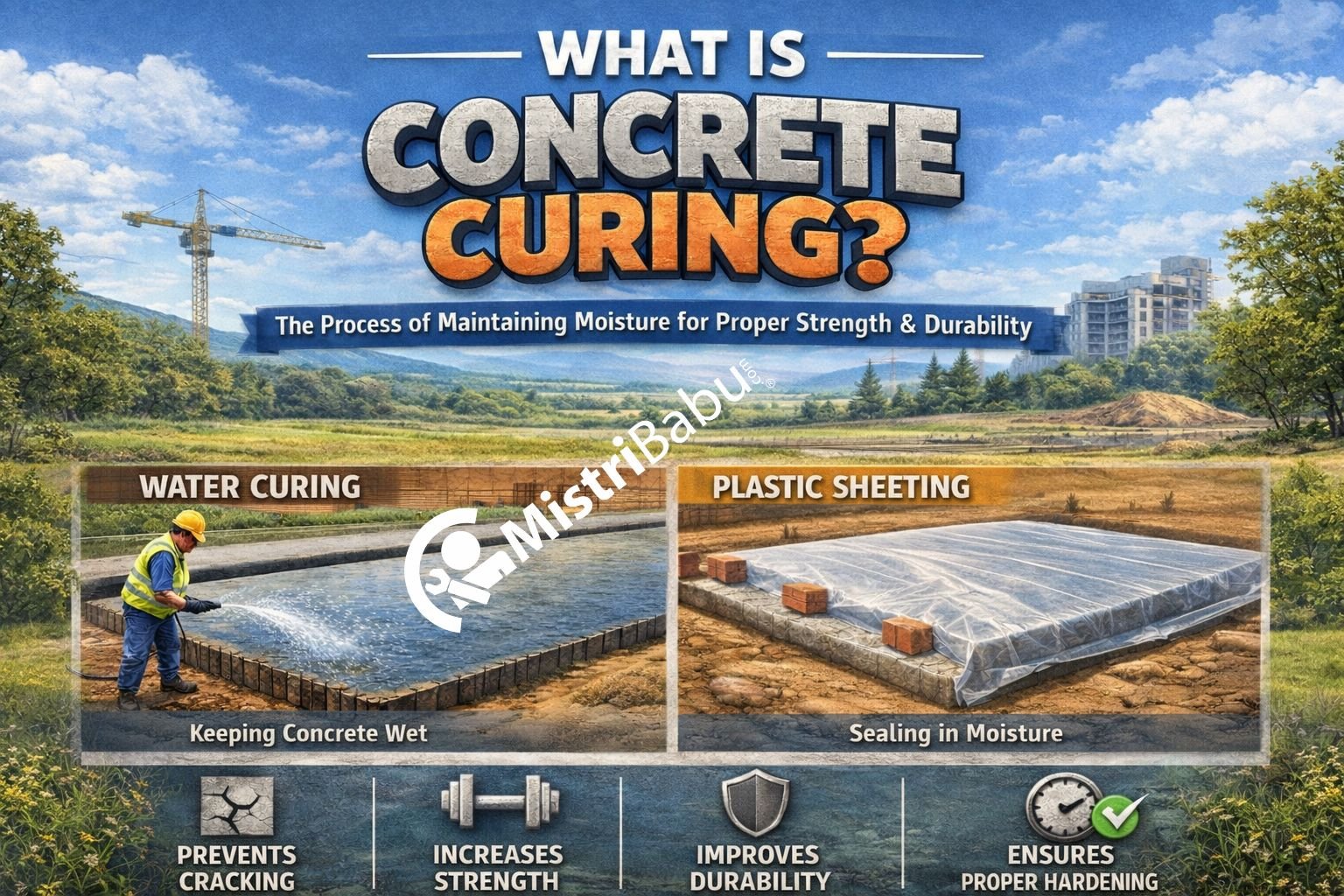
Concrete is one of the most widely used construction materials in India — from small village homes to metro city skyscrapers. But many homeowners and even small contractors overlook one critical process after concrete pouring: Concrete Curing.
Proper curing ensures strength, durability, and long life of structures whether you are building in Andhra Pradesh or Arunachal Pradesh, Gujarat or Goa, Tamil Nadu or Telangana.
What Is Concrete Curing?
Concrete curing is the process of maintaining adequate moisture, temperature, and time after placing concrete so that it achieves its required strength and durability.
When cement reacts with water, a chemical process called hydration occurs. If water evaporates too quickly, hydration stops, and the concrete becomes weak, cracked, and dusty.
Proper curing allows:
-
Maximum strength development
-
Crack prevention
-
Improved durability
-
Better surface hardness
-
Resistance against weather damage
Why Concrete Curing Is Important in Indian Climate
India has diverse climate conditions:
-
Extremely hot summers (Rajasthan, Delhi, Telangana)
-
Heavy rainfall regions (Kerala, Assam, Meghalaya)
-
Coastal humidity (Goa, Tamil Nadu, Odisha)
-
Cold winters (Himachal Pradesh, Uttarakhand, Jammu & Kashmir)
Because of this variation, curing becomes even more important.
Without curing:
-
Surface cracks develop
-
Concrete loses strength up to 30–40%
-
Structural durability reduces
-
Repair cost increases
Minimum Curing Time in India
As per Indian construction standards:
-
Ordinary Portland Cement (OPC): Minimum 7 days
-
Blended Cement (PPC/PSC): Minimum 10–14 days
-
Hot Weather Conditions: 10–14 days minimum
-
Important Structural Members (Slab, Beam, Column): 14 days recommended
For best results in Indian climate, 14 days curing is ideal.
Types of Concrete Curing Methods
1. Water Curing (Most Common in India)
This method involves keeping concrete continuously wet.
Methods include:
-
Ponding (for slabs)
-
Sprinkling water
-
Wet gunny bags covering
-
Immersion (for precast elements)
Best for: Residential houses, slabs, roofs.
2. Membrane Curing
A curing compound is sprayed on the surface to prevent water evaporation.
Used in:
-
Large commercial projects
-
Road construction
-
Industrial floors
3. Steam Curing
Used in precast factories for fast strength gain.
4. Curing with Plastic Sheets
Concrete is covered with polyethylene sheets to retain moisture.
Cost-effective for small projects.
Step-by-Step Concrete Curing Process
-
Wait 6–8 hours after pouring concrete.
-
Start light water sprinkling.
-
Ensure continuous moisture for at least 7–14 days.
-
Avoid heavy load during curing period.
-
Protect from direct sunlight and wind.
Common Mistakes in Concrete Curing
-
Stopping curing after 2–3 days
-
Allowing surface to dry completely
-
Not curing vertical surfaces (columns, walls)
-
Using insufficient water
-
Ignoring curing in winter
Concrete Curing for All States of India
Concrete curing is equally important in every Indian state and union territory:
States of India:
-
Andhra Pradesh
-
Arunachal Pradesh
-
Assam
-
Bihar
-
Chhattisgarh
-
Goa
-
Gujarat
-
Haryana
-
Himachal Pradesh
-
Jharkhand
-
Karnataka
-
Kerala
-
Madhya Pradesh
-
Maharashtra
-
Manipur
-
Meghalaya
-
Mizoram
-
Nagaland
-
Odisha
-
Punjab
-
Rajasthan
-
Sikkim
-
Tamil Nadu
-
Telangana
-
Tripura
-
Uttar Pradesh
-
Uttarakhand
-
West Bengal
Union Territories:
-
Andaman and Nicobar Islands
-
Chandigarh
-
Dadra and Nagar Haveli and Daman and Diu
-
Delhi
-
Jammu and Kashmir
-
Ladakh
-
Lakshadweep
-
Puducherry
Whether you are constructing in Mumbai, Delhi NCR, Bhubaneswar, Chennai, Kolkata, Hyderabad, Bengaluru, or any rural district, curing standards remain essential.
Effects of Poor Concrete Curing
If curing is not done properly:
-
Reduced compressive strength
-
Surface powdering
-
Plastic shrinkage cracks
-
Structural weakness
-
Water seepage issues
-
Reduced lifespan of building
Poor curing is one of the main reasons for slab cracks in Indian homes.
Best Curing Practices for Indian Homes
-
Start curing within 6–8 hours
-
Continue minimum 10–14 days
-
Use ponding for roof slabs
-
Cover vertical members with wet cloth
-
Increase frequency in summer
-
Protect from frost in cold states
Advantages of Proper Concrete Curing
✔ Higher strength
✔ Long structural life
✔ Crack-free surface
✔ Better resistance to rain and heat
✔ Lower maintenance cost
1. What happens if concrete is not cured?
Concrete loses strength, develops cracks, and becomes weak. It may reduce strength up to 30–40%.
2. How many days should concrete be cured in India?
Minimum 7 days, but 14 days is recommended for better strength.
3. Can curing be done only by sprinkling water?
Yes, but continuous moisture must be maintained. Ponding is better for slabs.
4. Is curing required in winter?
Yes. Even in winter (Himachal Pradesh, Uttarakhand, Jammu & Kashmir), curing is necessary to maintain hydration.
5. What is the best curing method for house construction?
Water curing (ponding and wet covering) is the best and most economical method for residential buildings in India.
6. When should curing start after concrete pouring?
Curing should start within 6–8 hours after placing concrete, once initial setting begins.
7. Is curing required for columns and beams?
Yes. All structural elements including slabs, beams, columns, and footings must be cured properly.
8. Can over-curing damage concrete?
No. Extra curing does not harm concrete. It only improves strength and durability.
Final Conclusion
Concrete curing is not an optional step — it is a critical part of construction. Whether you are building a small house in Odisha or a commercial complex in Maharashtra, proper curing ensures long-term structural safety and durability.
Never compromise on curing time. A few extra days of water can add decades to your building’s life.
If you are planning home construction anywhere in India, always ensure your contractor follows proper curing practices.

MistriBabu
Admin